How can late-maturing apples be managed during the August swelling period to increase yield?
August is the period of secondary flower bud differentiation for apple trees and the swelling period for mid- and late-maturing apple varieties. During this time, photosynthesis is intense, photosynthetic accumulation accelerates, and vigorous new shoots grow faster, but most new shoots transition from slow growth to stopped growth, absorption roots develop in large numbers, and the absorption of water and nutrients also accelerates. The key points for apple tree management in August are:
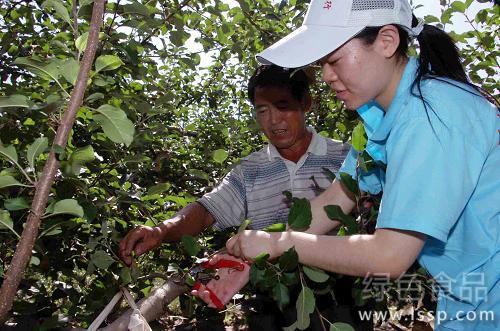
Apple tree pruning
I. Pruning
In early August, shorten and prune the vigorous shoots of young apple trees to promote secondary side shoots, which can form flower buds in the same year, achieving the goals of more flower formation and early high yield, and can cultivate branch groups and control the tree canopy. The cutting position is best at the base of the spring shoot, leaving 3-5 leaves. In early August, for large trees with too many auxiliary branches, some large branches can be thinned out, and water sprouts, upright shoots, and overly vigorous shoots should also be thinned or pruned according to space, to improve ventilation and light conditions for the apple tree and improve flower bud quality. In early August, bend and open the angle of one-year-old long shoots, injuring the xylem of the new shoot segment, causing the branch tissue to be damaged and droop or become horizontal, to inhibit apical dominance, promote the sprouting of secondary side shoots, and increase the amount of branches and leaves on young trees. From late August, begin pulling branches to open the angle. At this time the branches are relatively soft, and after the angle is opened, the upper side of the branch is not prone to producing water sprouts. This is a good time to pull and open the angle of scaffold branches and large auxiliary branches. Before young trees take shape, branch pulling must be maintained every year; when pulling branches to open the angle, be sure not to pull them into a bow shape.
II. Soil, fertilizer, and water management
Along with pesticide spraying, spray the leaves with 0.3% urea + 0.5% monopotassium phosphate to promote new shoot maturity and improve cold resistance. Spray once more after 10 days to enhance apple coloring and increase sugar content. In apple orchards with bitter pit disease, spray 0.5-1% calcium chloride 2-3 times continuously in early August, mainly spraying the apples, which can increase flesh firmness and improve storage tolerance. In mid-August, autumn shoots gradually stop growing. Applying compound fertilizer can prevent premature leaf aging, promote nutrient accumulation in apple trees, restore tree vigor, help flower bud differentiation and apple swelling, and help increase the fruit-setting rate the following year and increase new shoot growth. Watering together with topdressing has a good effect on increasing yield, enhancing coloring, and improving quality. After watering or rain, cultivate and weed in time. Young orchards can be deep-plowed to a depth of about 20-30 cm to thoroughly remove weeds and promote root growth.
Apple bag removal
III. Apple management
For bagged apples of mid-maturing varieties, begin removing bags from mid-to-late August. For double-layer bags, remove the outer layer first, then remove the inner layer after 3-5 days; for single-layer bags, first tear the paper bag lengthwise, leave the remaining bag on the apple, and remove it after 3-5 days. Be careful to choose a time of day when the temperature difference inside and outside the bag is small for bag removal. After bag removal, carry out leaf removal, fruit turning, and reflective film laying to promote full coloring of the fruit. For Delicious strain varieties prone to pre-harvest fruit drop, spray 30-40 mg/kg naphthaleneacetic acid once each in mid-August and at the end of August, that is, one month and half a month before harvest, to prevent pre-harvest fruit drop.
IV. Pest and disease control
Continue to inspect and treat rot disease. Alternately use 1:2-3:200 Bordeaux mixture, 50% iprodione wettable powder 1000-1500 times solution, and 50% mancozeb wettable powder 500 times solution to control anthracnose, ring rot, spotted leaf fall disease, and other diseases. When diseased apples are found, remove them promptly and bury them deeply. Use 25% chlorbenzuron No. 3 2000 times solution to control Lepidoptera pests such as the apple leafminer and the smaller apple leaf roller. In late August, tie grass bundles on apple tree trunks to attract pests such as red spider mites to overwinter. Remove and burn them before thawing the following year to reduce pest population density. When bag removal inspection reveals mealybug larvae, spray the trees with 52.25% chlorpyrifos 1500-2000 times solution to control their damage.