Lettuce Sclerotinia rot causes the whole plant to die - how should it be prevented and controlled
Lettuce brings good returns, so many people grow it, but lettuce Sclerotinia rot is quite severe every year. As the season for planting lettuce has come around again, the methods for preventing and controlling lettuce Sclerotinia rot are provided here to help everyone suffer fewer losses.
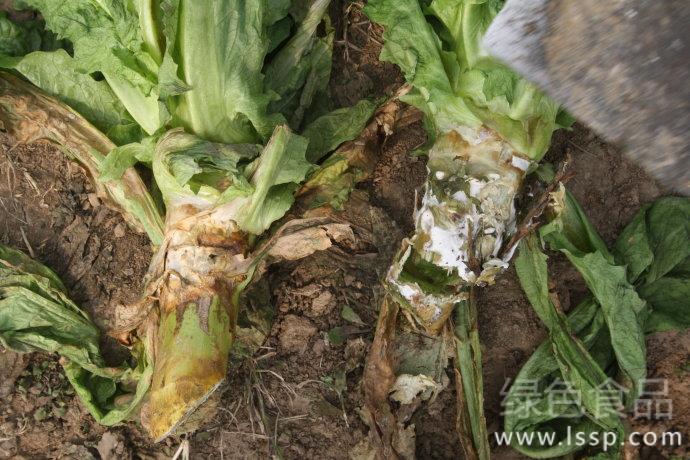
Lettuce Sclerotinia rot
Symptoms: On the stem of the lettuce near the ground surface, it first appears water-soaked, then rapidly spreads upward to the upper stem and downward to the roots, causing the diseased tissue of the lettuce to become soft and rotten, with the surface covered in white cottony mycelium. Afterwards, the mycelium interweaves to form sclerotia that are initially white and later become black and mouse-dropping-shaped. When the aboveground stem and leaf petiole of the lettuce are affected, the symptoms are similar. After the lettuce is infected, the aboveground leaves wilt, and finally the whole plant dies.
Disease occurrence pattern: Sclerotinia rot overwinters in the soil as sclerotia. When the temperature is about 20°C and the relative humidity is above 85%, it is favorable for the growth and development of the Sclerotinia rot pathogen, and the disease occurs severely.
Prevention and control methods:
1. Select lettuce varieties with strong disease resistance.
2. Practice crop rotation and deep plowing of the soil to bury the sclerotia deep in the soil.
3. Strengthen field management, fertilize reasonably, and by all means avoid applying excessive nitrogen fertilizer; increase the application of phosphorus fertilizer. Promptly pull out diseased plants to reduce mutual infection during the growth period of the lettuce plants. Promptly drain accumulated water to lower ground humidity. Ensure good ventilation and light penetration.
4. During the disease period, per mu, 15-20 kg of quicklime can be mixed evenly with 15 kg of fine soil and scattered between the lettuce rows; a 250-fold solution of 25% carbendazim wettable powder or a 1500-2000-fold solution of 70% thiophanate-methyl wettable powder sprayed on the middle and lower stems and leaves of the lettuce plants has a good effect.