The quality of onion seedlings determines the yield: key technical points for growing onion seedlings
1. Selection of seedbed site: Onion seeds are small, the cotyledons have difficulty emerging from the soil at germination, and the seedlings grow slowly, so it is best to choose a plot with relatively high terrain, convenient drainage and irrigation, and fertile loam or sandy loam soil that has not grown allium vegetables within 2 to 3 years.
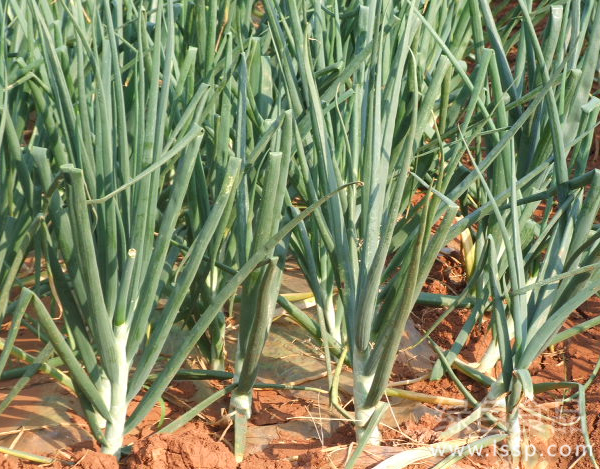
Onion
2. Land preparation and fertilization: Dig and turn the plot, level the bed surface so that the seedbed soil is relatively fine, and make the clear bed surface 1.2 to 1.5 m wide to facilitate intertillage management and moisture retention. On the leveled bed surface, apply 1 kg of fine dry manure per sq m, and shallowly hoe to level the bed surface.
3. Sowing: Sow from late August to early September; it is better to sow later than earlier, because sowing too early readily produces scallion-like plants, affecting onion quality. The sowing rate is calculated at 150 to 200 g of seed per mu of main field, with a seedbed area of 15 to 20 sq m (that is, a seedbed-to-main-field ratio of 1:30 to 40). Evenly scatter the seeds on the seedbed, then cover with 0.5 to 1 cm of granular fine soil or leaf mold; the covering soil should be selected from land that has not grown allium crops.
4. Disinfection and insect killing of seedbed soil: After sowing and covering with soil, apply carbendazim + phoxim mixed with water to disinfect and kill underground pests.
5. To keep the seedbed moist, after sowing, add mulch such as pine needles or rice straw, and set up a shade net with 50% shading rate, watering moderately to keep the surface moist.
6. Seedling-stage management: Onion seedlings emerge about 7 to 10 days after sowing. After emergence, gradually remove the mulch in the evening, and use metaldehyde granules to control snails. After emergence, keep the soil moist; watering should be done early, late, lightly, and frequently. After the 3-leaf stage, water once every 1 to 2 days. From 15 to 20 days after emergence, topdressing can be carried out according to seedling condition.
7. Disease control at the seedling stage: When the second leaf grows after onion emergence, apply carbendazim + dexon mixed with water to control damping-off, Rhizoctonia rot, and gray mold, with an interval of 7 days, for 2 consecutive treatments.