When chives are infected with rust disease, they lose their value. How can it be prevented and controlled?
Rust disease mainly infects the leaves and flower stalks of chives. It is a fungal disease spread by airflow. In the early stage of the disease, hammer-shaped or oval raised orange-yellow small blister spots appear on the epidermis, and there is a yellow halo around the lesions. Later they expand into large blister spots, and after the epidermis ruptures, orange-yellow powdery material appears. Both sides of the leaves can be infected. In the later stage, black small blister spots appear on the leaves and flower stems of the chives. When the disease is severe, the lesions cover the entire chive leaves. In the whole bed of chives, the leaves turn yellow and emit rust powder, losing their edible value.
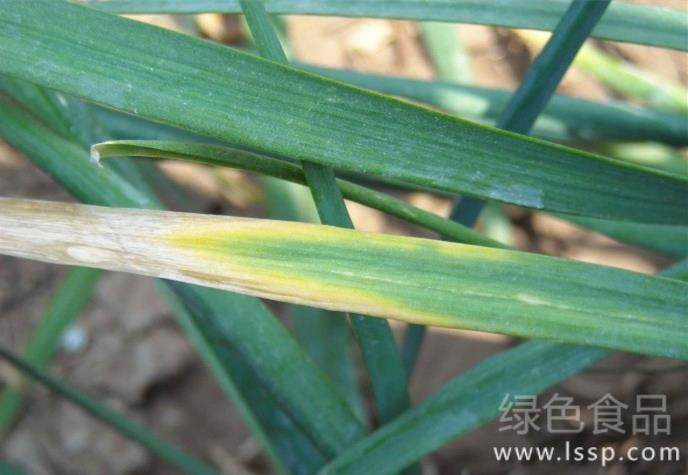
Chive rust disease
Prevention and control methods:
1. Select excellent chive varieties adapted to different periods: such as Beijing Dabai Gen, Beijing Daqing Miao, Hanzhong Dongjiu, Shouguang Dugenhong, Shandong 9-1, etc., which can reduce the incidence of disease.
2. Rational crop rotation to reduce the accumulation of inoculum sources. For planting in the field, choose fertile soil with sufficient organic matter. Before planting, water thoroughly and apply sufficient base fertilizer. Apply 3000 kg of fully decomposed manure and other farmyard manure per mu, 30 kg of 25% compound fertilizer, and spray a disinfectant plus Xin Gao Zhi Mo 800-fold solution on the soil surface to disinfect the soil.
3. Rational close planting, good ventilation and light transmission, timely drainage after rain, and prevention of excessively high humidity; use formula fertilization technology, apply more phosphorus and potassium fertilizers to improve disease resistance, and at the same time spray Xin Gao Zhi Mo 800-fold solution to form a protective film to prevent pathogen invasion, and spray Zhuang Jing Ling at the appropriate time during the chive growth stage, which can make the chive stems thick, the leaves thick, the leaf color fresh and tender, the plants luxuriant, and the natural taste strong.
4. When harvesting, cut as low as possible. Pay attention to cleaning the bed surface. After harvesting, spray the bed surface with 45% sulfur suspension concentrate 400-fold solution for disinfection, and at the same time spray Xin Gao Zhi Mo 800-fold solution to enhance the efficacy, improve the utilization rate of the effective ingredients of the pesticide, and consolidate the control effect.
5. In the early stage of the disease, spray pesticide in time. Spray 25% propiconazole emulsifiable concentrate 3000-fold solution or 25% tebuconazole aqueous emulsion 3000-fold solution, 30% difenoconazole · propiconazole emulsifiable concentrate 3000-fold solution, 15% triadimefon wettable powder 2000-fold solution, spray once every about 10 days, for 2 treatments.
6. For plots with severe disease, chemical control cannot stop it. It is best to cut evenly from the root stems at the ground, spray a fungicide once on the remaining root stem parts, and strengthen management, increase fertilizer application, accelerate chive growth, and allow the chives to grow back.