To achieve stable and high yields in sesame, you need to master the "Ten Changes" techniques
1. Change continuous cropping to rotation. Sesame has many diseases, and the pathogens are mostly soil-borne, so continuous cropping is not advisable; rotation should be practiced with an interval of more than 2 years.
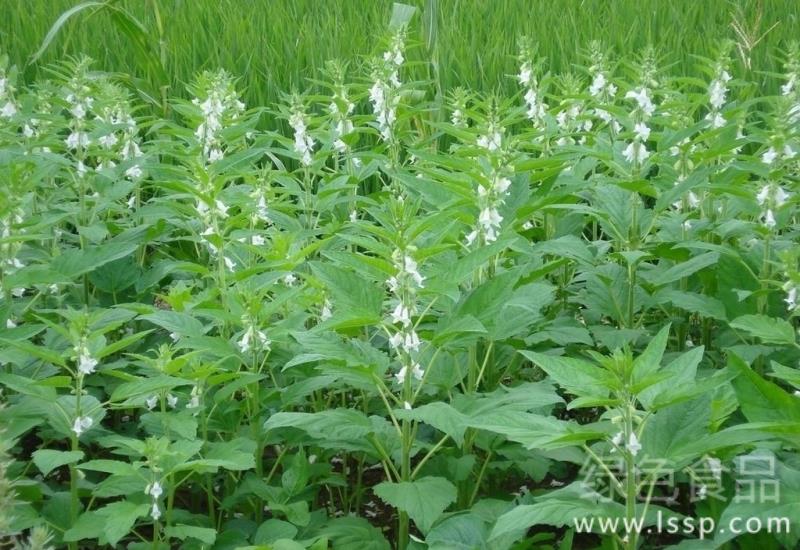
Sesame
2. Change flat planting to high-ridge planting. Sesame is not tolerant of waterlogging; high ridges drain well and are good for sesame growth. The standard for high ridges: ridge width 140 cm, furrow width 30 cm, furrow depth 15-20 cm. In addition, during continuous rainy weather, clear the furrows and drain water promptly to prevent flooding and waterlogging.
3. Change waiting for rain and late sowing to artificially creating soil moisture and early sowing. Sesame likes warmth; if it encounters low temperatures in the later growth stage, photosynthesis weakens, yellow tips grow long, grains are shriveled, yields are low, and quality is poor. Therefore, after the wheat harvest, ridges should be made and soil moisture created promptly, striving for early sowing.
4. Change a single sowing method to a "double insurance" sowing method. First drill 3/5 of the seeds, then broadcast the remaining 2/5 of the seeds and level the soil, achieving full emergence in one sowing.
5. Change excessive density to a reasonable density. For single-stem sesame, plant 10,000-12,000 plants per mu; for branching sesame, planting about 8,000 plants per mu is appropriate.
6. Change pest control only to combined disease and pest control. The traditional method is to control only aphids and hawk moths, without preventing and controlling diseases. Sesame has many diseases, such as stem spot blight, bacterial wilt, and root rot; stem spot blight in particular causes severe damage in years with more rain, reducing yields or even causing total crop failure. If carbendazim is sprayed once each at the seedling stage, early flowering stage, and full flowering stage, the control effect is good and the yield increase is obvious.
7. Change no topdressing to topdressing. In the Huaibei region, at sowing time, apply 7-8 kg of ternary compound fertilizer and then no more fertilizer; but sesame only enters its growth period after the early flowering stage, which is the peak period of fertilizer demand. At this time, 7-8 kg of urea per mu is needed, and the yield increase effect is obvious.
8. Change leaf removal to no leaf removal. If leaves are removed, the photosynthetic products of sesame will inevitably decrease, resulting in poor quality and low yield. Therefore, leaves must absolutely not be removed.
9. Change no topping to topping. The growing tip should be removed at the final flowering stage of sesame to save nutrients, make the sesame seeds plump, and improve yield and quality.
10. Change pile sweating to timely sun-drying. Pile sweating easily generates heat, making sesame seeds neither white nor bright, or even gray, reducing oil content. After harvesting, tie into small bundles and sun-dry and thresh promptly.