Key points for topdressing longan at three stages, apply fertilizer skillfully to promote high yield
For longan, flower bud differentiation occurs in the same year, and flowering and fruiting also occur in the same year, so its fertilizer requirement period is related to its phenological period. In February, longan spring buds sprout, flower primordia form, and after inflorescence differentiation and flower organ formation, flowering follows, then the fruit grows and develops. Longan fertilization periods are combined with phenology and are divided into three stages throughout the year: pre-flowering fertilizer, young fruit fertilizer, and post-harvest fertilizer.
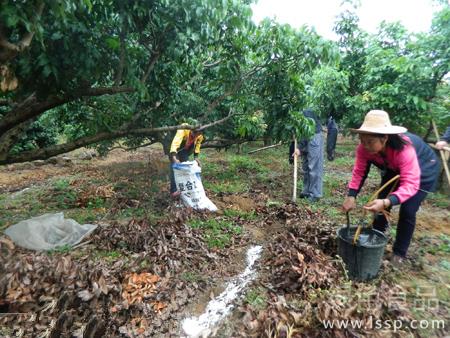
Longan fertilization
1. Pre-flowering fertilizer: Fertilizing before flowering promotes flower bud differentiation and flower spike development, improves quality, reduces flower drop, supplements the nutrient deficiency of longan trees after late flowering, increases fruit set, promotes early summer shoot growth, and strengthens fruit and promotes shoots. Fertilization at this stage is the most critical. The amount applied accounts for more than 50% of the whole year, mainly nitrogen fertilizer, combined with phosphorus and potassium fertilizers; nitrogen, phosphorus, and potassium fertilizers are combined, with a nitrogen, phosphorus, and potassium ratio of 1:0.16:0.54, and organic fertilizer and chemical fertilizer each accounting for half. For every 50 kg of longan produced, apply 1-2 kg of compound fertilizer, 0.5 kg of urea, and 0.25 kg of potassium chloride. However, this period often encounters weather with temperatures above 18°C, so it is necessary to prevent excessive nitrogen application, which can cause "shoot flushing" and affect yield. Tests show that applying heavy fertilizer before flowering gives the best effect. The fertilization time is about mid-March to early April, and earlier is better than later; apply when the longan flower spike inflorescence has formed and flower buds appear. If low temperatures occur in the previous winter and early spring of the same year, making flower spike emergence difficult, then apply a spike-promoting fertilizer once from late January to early February, with the amount accounting for 1/3 of the pre-flowering fertilizer, and apply the other 2/3 in early April.
2. Young fruit fertilizer: Young fruit fertilizer can supplement the nutrients consumed by longan trees during flowering, promote longan expansion, prevent fruit drop, promote robust summer shoot growth, increase per-unit yield, and reduce alternate bearing. The amount applied at this stage accounts for about 20% of the whole year, mainly phosphorus and potassium fertilizers, combined with nitrogen fertilizer. The fertilization time can be in early to mid-June after the first physiological fruit drop following petal fall, when young fruits are the size of soybeans; apply appropriately once according to tree vigor and fruit load. Apply once in mid-July during the rapid growth period of the aril. For each application, for every 50 kg of longan produced, apply 1.5-2 kg of compound fertilizer, 1.5-2 kg of potassium chloride, and 0.5 kg of urea, with a nitrogen, phosphorus, and potassium ratio of 1:0.16:1.24.
3. Post-harvest fertilizer: Post-harvest fertilizer, also called fruiting mother branch maintenance fertilizer, is divided into pre-harvest and post-harvest. The purpose of fertilization is to promote late-stage longan growth and post-harvest tree vigor recovery, and to encourage the last autumn shoots to sprout on time around mid-September and mature in mid-to-late November. Fertilization at this stage is very important because autumn shoots are the fruiting mother branches for the next year, and whether autumn shoots emerge well affects the next year's longan yield. According to the growth characteristics of longan, pre-harvest fertilizer is the main one, applied 10-15 days before harvest, with the application amount accounting for 30% of the whole year, mainly nitrogen fertilizer, combined with phosphorus and potassium fertilizers. For every 50 kg of longan produced, apply 1 kg of urea, 0.5 kg of potassium chloride, and 0.25 kg of magnesium sulfate. For trees with a heavy fruit load that year, weak trees, and old trees that have difficulty sprouting after harvest, quick-acting nitrogen should be applied again after harvest to promote autumn shoot emergence. During autumn drought, fertilization at this stage should focus on orchard irrigation to achieve good results.
In addition, foliar topdressing is a fast and efficient fertilizer supplement measure in longan cultivation management and is essential for high and stable longan yields. Foliar fertilization does not need to be used alone; it can be combined with flower and fruit preservation and pest and disease control. Apply 4-5 times throughout the year, depending on the growth status of the longan tree. The selected fertilizer types and concentrations are urea 0.3%-0.5% and borax 0.1%-0.2%, used from new shoot leaf expansion until before turning green. The last foliar fertilization should be carried out 20 days before longan harvest.