New no-till potato cultivation technique with straw mulching: less labor, high returns
The no-till potato cultivation technique with straw mulching is simple and easy to carry out, saves labor, and gives high yields and good returns. The specific method:
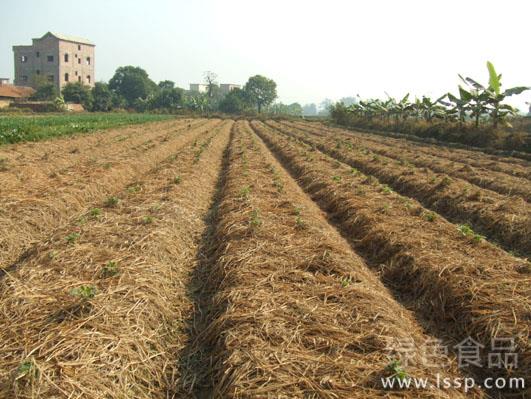
Potatoes mulched with straw
Sow at the right time: For straw-mulched potatoes, generally 1 mu of potatoes requires 2 mu of straw. Therefore, rice stubble fields can use this technique to grow autumn potatoes. In central Zhejiang, sowing can be done in early to mid-September; in mountainous areas, in mid to late August. If using fields after late double-cropped rice, then grow spring potatoes, sowing in early February.
Seed potato treatment: For autumn potatoes, it is best to use varieties with a short growth period, fast tuber bulking, and a short dormancy period, such as “Dongnong 303”, “Zhongshu No. 3”, and “Zhengshu 85-2”. Generally, small spring potato tubers introduced from Northeast China that same year are used as seed potatoes, with 130-260 kg of seed used per mu. Before sowing the seed potatoes, artificial measures should be used to break their dormancy period; that is, 7-10 days before sowing, soak the seed in cold reservoir water or well water for 1 hour, or soak in a 5-10 ppm 920 aqueous solution for 30 minutes, then remove, air-dry, and place in a cool place to promote sprouting. When the sprouts are about 1 cm long, they can be sown.
Land preparation and sowing: For rice fields where potatoes are sown without tillage, determine the bed width according to soil texture and soil drainage conditions, generally 2-2.5 m. The original “high-yield furrows” in the rice field can be used to clean the ditches and make beds. If the original rice beds are too wide, 1-2 additional ditches can be opened in the center, and the ditch mud broken up and spread on the center of the bed so that the bed surface is slightly arched, which helps drainage and prevents waterlogging. Apply 1000-1500 kg of decomposed organic fertilizer and 30-40 kg of compound fertilizer per mu as base fertilizer. Organic fertilizer can be broadcast or used as a seed-covering fertilizer. When sowing, small tubers are sown whole, while large seed potatoes can be cut into small pieces each with 2-3 buds and soaked in a 2500-5000 times dilution of 50% carbendazim wettable powder. After the cut surfaces are slightly dry, coat the cut surfaces with plant ash and sow the next day. When sowing, place the tubers directly on the bed surface and press down lightly so that the seed potatoes make full contact with the soil. The sowing row spacing is 40-50 cm and the plant spacing is 25-30 cm; the outer rows can be appropriately denser, with a row spacing of about 20 cm. After arranging the tubers, apply fertilizer, placing compound fertilizer between the rows and more than 5 cm away from the tubers, so as to avoid contact between chemical fertilizer and seed potatoes that could cause seed rot.
After sowing, straw can be spread as mulch, generally 8-10 cm thick. The direction of the straw should be perpendicular to the bed edge, with the base of the straw connected to the top, covering the entire bed. The thickness should be uniform, with no gaps left. If the covering is uneven or too thin, light leakage easily occurs; when the tubers grow larger, exposure to light will cause green skins and affect market quality. It also should not be covered too thickly, with the maximum thickness not exceeding 15 cm. At the same time, avoid the straw crossing and tangling with each other, so as not to affect seedling emergence.
Field management: After sowing, soil moisture is generally maintained by rainfall. If an autumn drought occurs in the early stage, then irrigate with “horse-running water” to ensure emergence and achieve uniform, strong seedlings. The straw mulch will suppress weed growth and reduce diseases of potato plants, so it is possible not to apply pesticides, not cultivate, not apply topdressing, and not weed. Generally, small weeds and rice stubble will not affect potato growth. If there are large weeds, they can be stepped down by foot or hoed away; there is no need to use herbicides.
Harvest in batches: After straw mulching, the potatoes will grow on the bed surface. Simply push aside the straw to pick and harvest them. Even if a small number of tubers enter the soil, they are still very easy to harvest. At the same time, harvesting can be done in batches according to market conditions and tuber size. Harvest the large ones first, and the remaining small tubers can continue to grow after being covered again with straw.