How to do a good job of autumn management during the citrus fruit-swelling and shoot-flushing period
Autumn is the key period for citrus fruit swelling and shoot flushing, and management must be strengthened to achieve high yields. The techniques are as follows:
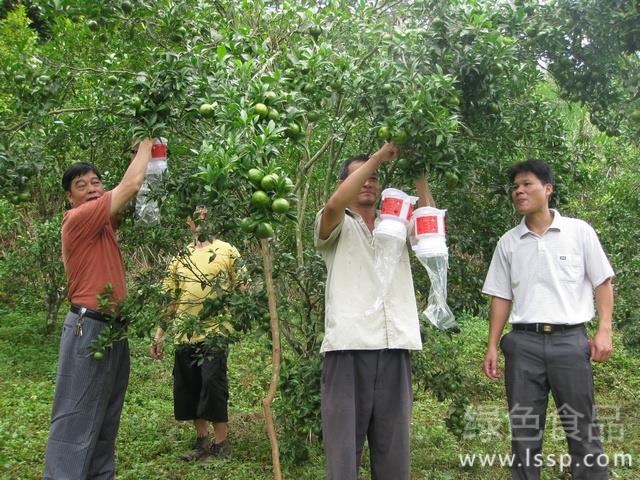
Autumn management of citrus
1. Apply autumn fertilizer heavily to swell the fruit and promote shoots. Before mid-September, apply a heavy dose of fertilizer to the citrus to swell the fruit and promote shoots. Dig a ring-shaped fertilization trench 1-1.2 m long and 0.3 m deep and 0.3 m wide near the drip line of the canopy. For each adult bearing citrus tree, apply 100-200 kg of decomposed human and livestock manure or composted manure, plus 1.5-2 kg of superphosphate, and 1-1.2 kg of urea or 2 kg of ammonium bicarbonate. For young bearing trees, use half these amounts, and for young trees, halve them again.
2. Irrigate to retain moisture, fight drought and preserve fruit. During the summer drought period from August to September, irrigate the citrus orchard in the early morning and evening, with no less than 100-150 kg per bearing citrus tree each time. Also cover the ground with weeds, wormwood stalks, vines, etc., to retain moisture, resist drought and preserve fruit.
3. Thin buds to nourish shoots, and ring-cut to promote flowering. In late September, use a sharp budding knife to make 1-3 complete rings on the 2nd-3rd order branches of citrus trees that bore few fruits this year but are growing too vigorously, cutting deep to the xylem, to promote flower bud differentiation. About 20 days after ring-cutting, spray once with 0.2% potassium dihydrogen phosphate and 0.3% urea, plus a 30-40 ppm 2,4-D solution (take 30-40 ml of 2,4-D aqueous solution at a concentration of 5%), for 3-4 consecutive times, which can prevent leaf drop in winter and spring.
4. Multi-head top grafting to replace with improved varieties. In early September, carry out multi-head top grafting to change varieties on inferior, low-yield citrus trees under 30 years old that are growing normally, to develop high-quality navel oranges such as Fengqi, Pengna and Qingjia, superior-line Jincheng, and extra-early-maturing Satsuma mandarins such as Xieshan, Gongmu and Dapu. Use the "single (double) bud side grafting" method, grafting the buds evenly onto upright and slanting branches about 2 cm in diameter in the middle-upper part of the canopy. After they survive, cut back the stock in April of the following year.
5. Forecasting and prevention and control of diseases and pests. From August to October, with high temperature and high humidity, citrus diseases and pests occur frequently. Focus on preventing and controlling anthracnose, citrus rust mite, red spider mite, arrowhead scale, etc. During the summer drought period, when "black charcoal balls" appear on young citrus fruits, immediately use 0.3-0.4 ppm lime sulfur mixture to control them 1-2 times; for citrus red spider mite, observe the new leaves of the current year's shoots, and when there are about 5 mites per citrus leaf, spray once with 15% mie man jing emulsifiable concentrate at 3000 times dilution to kill them; in early to mid-September, during the peak occurrence period of arrowhead scale, when about 50% of the young scales have laid eggs, spray 40% supusha emulsifiable concentrate at 1200 times dilution 1-2 times.