Sugarcane has high water requirements. What are the key points to note for irrigation?
Sugarcane has high yields and relatively large water requirements. The water demand pattern across the entire growth stage of sugarcane can be summarized as "small at both ends, large in the middle." That is, during the germination and tillering stages, water demand is low; during the elongation stage, water demand is high; and during the maturation stage, water demand is also low. Therefore, rational irrigation helps improve sugarcane yield and quality. Only by scientifically understanding the water requirements of sugarcane at different growth stages can the yield-increasing advantage of irrigation be brought into fullest play.
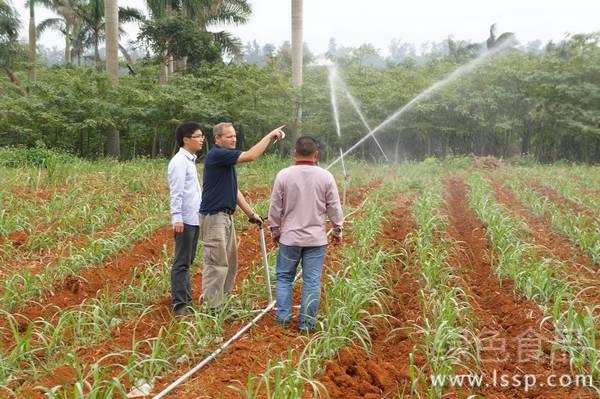
Sugarcane irrigation
Germination stage: water demand is not high, accounting for 8.4%-18.1% of the total water demand over the whole growth period. The main purpose is to maintain the ecological water needed for sugarcane seed cane germination and ensure early emergence and uniform seedlings. During this period, the moisture content of the top approximately 25 cm of soil should be kept at 55%-70% of maximum water-holding capacity. If it falls below 55%, irrigate promptly, but irrigation should be shallow; at the same time, prevent waterlogging in the field to avoid rotting of the sugarcane seed cane.
Tillering stage: the plants are not large, the leaves are few and small, transpiration is not great, and water demand is not high, accounting for 15.4%-21.7% of the total. However, sugarcane has weak drought resistance. At the same time, this period falls in the season of the year with strong sunlight, higher temperatures, little rain, and drought, and the sugarcane in the field has not yet fully closed its rows, so soil surface evaporation is high, and soil drought will inhibit tillering. Therefore, at this stage, attention should be paid to frequent and shallow irrigation, keeping the moisture content within the top 30 cm of soil at 60%-80% of maximum water-holding capacity, to promote early tillering and early growth of young seedlings.
Elongation stage: this is the key period of fastest growth and yield formation, with water demand accounting for 54.3%-57.8% of the total. Although this period has entered the rainy season, the sugarcane rows in the field have closed, and soil evaporation has weakened, the leaf area index, leaf transpiration, and root absorption capacity of sugarcane all reach their maximum. The number and amount of irrigation should be determined according to rainfall. In sugarcane areas with relatively little rainfall or long periods of drought without rain, carry out furrow irrigation or flood irrigation promptly to ensure thorough water penetration, keeping the moisture content within the top 50 cm of soil above 80% of maximum water-holding capacity, so as to ensure continuous soil moisture supply. At the same time, clear the field drainage and irrigation ditches to prevent waterlogging in the field.
Maturation stage: after entering the maturation stage, the elongation growth of sugarcane gradually weakens, sugar accumulation accelerates, and water demand declines. The number and amount of irrigation should be controlled. During this period, flood irrigation must be avoided to prevent sugarcane lodging. Take care to keep the moisture content within the top 40 cm of soil at about 60% of the field maximum water-holding capacity, with the field topsoil moist but not wet, and dry but not pale, so as to facilitate sugar accumulation in sugarcane.