What are the effects and uses of copper hydroxide fungicide?
What is copper hydroxide fungicide used for? Please give an introduction to copper hydroxide fungicide: other names include Kocide, Guanjuantong, Fenghu'an, etc. Common formulations include 77% copper hydroxide wettable powder, 57.6% copper hydroxide dry granules, 37.5% copper hydroxide suspension concentrate, 25% copper hydroxide suspension concentrate. At present in agriculture...
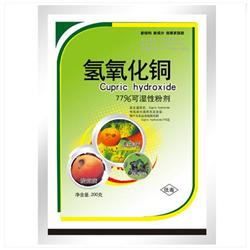
What is copper hydroxide fungicide used for? Please give an introduction
Copper hydroxide fungicide: other names include Kocide, Guanjuantong, Fenghu'an, etc. Common formulations include 77% copper hydroxide wettable powder, 57.6% copper hydroxide dry granules, 37.5% copper hydroxide suspension concentrate, 25% copper hydroxide suspension concentrate. At present, there are about 35 manufacturing enterprises registered with the Institute for the Control of Agrochemicals of the Ministry of Agriculture. It mainly controls cucumber bacterial angular leaf spot, cucumber damping-off, leaf blight, margin blight, cucumber Fusarium wilt, tomato early blight, late blight, canker, soft rot, round spot, pepper white star disease, bacterial spot, bacterial wilt, and bacterial diseases of cabbage, watermelon, etc. For copper-sensitive crops such as peach, plum, pear, apple, persimmon, Chinese cabbage, soybean, wheat and other varieties, tests should be carried out first and use should be cautious.
Targets of control:
1. Vegetable disease control: For tomato early blight, use 133-200 g of 77% wettable powder per mu (equivalent to 103-154 g active ingredient/mu), generally add 75-100 kg of water, equivalent to a 500-750 fold dilution, mix thoroughly and spray on the leaves. The application period should begin before onset or at the early stage of the disease, generally spraying once every 7-10 days for a total of three sprays; use 150-177 g of 61.4% dry suspension concentrate per mu (equivalent to 92.1-107.5 g active ingredient/mu), generally add 75-100 kg of water, spray on the leaves, begin application at the early stage of the disease, then spray once every 10 days for a total of four sprays. It has a good control effect on early blight and can also control late blight. Compared with Bordeaux mixture, this product has better suspension and dispersibility, is convenient to use, and is safe for crops. The specific number of applications and the interval between two applications can be determined according to the severity of the disease. For cucumber angular leaf spot and downy mildew, use 150-200 g of 77% wettable powder per mu (equivalent to 115.5-154 g active ingredient/mu), generally add 75-100 kg of water, mix thoroughly and spray. Begin spraying at the early stage of the disease, then apply once every 7 days for 3-4 consecutive applications, which can effectively control angular leaf spot and downy mildew.
2. Fruit tree disease control: For citrus tree canker and root rot, use 77% wettable powder at a concentration of 300-800 fold solution (equivalent to 962.5-2567 mg/kg), that is, 100 g of product added to 30-80 kg of water, mix thoroughly and spray. The application period begins at the early stage of the disease, generally spraying 4-5 times, once every 7-10 days, depending on the severity of the disease. Generally, application is suitable at citrus petal fall stage, young fruit stage, young fruit diameter 0.8-1 cm, 1.5-2.3 cm, autumn shoots sprouting 2-3 cm, and after the autumn shoots self-unfolding stage. The concentration of 61.4% dry suspension concentrate is a 600-800 fold solution (equivalent to 767.5-1023.3 mg/kg). Begin spraying at the early stage of the disease, generally spraying 3-4 times with an interval of 10 days each time, which can effectively control canker and also control anthracnose. This product has excellent suspension and dispersibility, resists rain erosion, has a relatively long residual effect, is convenient to use, is safe for crops, and causes no phytotoxicity at the recommended dose. It is one of the copper formulations that can replace Bordeaux mixture.
Click to get more fungicide application techniques
Click to get more pesticide application techniques