What are the methods for controlling armyworms in Northeast China?
How do you control armyworms in Northeast China? Please give an introduction. The source of armyworms in Northeast China mainly comes from the Yangtze-Huai River basin. After the first-generation adults that occur in that region emerge, they usually migrate into Northeast China from late May to mid-June to lay eggs. Second-generation larvae appear in the fields in early to mid-June, and most larvae enter the third instar in mid-to-late June...
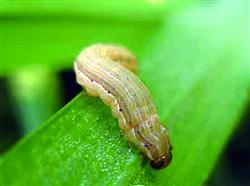
How do you control armyworms in Northeast China? Please give an introduction.
The source of armyworms in Northeast China mainly comes from the Yangtze-Huai River basin. After the first-generation adults that occur in that region emerge, they usually migrate into Northeast China from late May to mid-June to lay eggs. Second-generation larvae appear in the fields in early to mid-June, and most larvae enter the third instar in mid-to-late June. From early to late July, larvae successively pupate and emerge. Apart from those that remain locally to continue reproducing, most of the second-generation adults migrate southward back to the Yangtze-Huai River basin, becoming an external source of insects for that region. The peak period of the third-generation larvae remaining locally is mostly from late July to early-to-mid August, and in some years they can cause damage to foxtail millet and corn. From late August to early-to-mid September, they successively emerge, and most adults migrate southward, while the few that remain cannot form a damaging generation. Therefore, viewed nationwide, Northeast China is a frequent outbreak area for the second-generation armyworm and an occasional outbreak area for the third-generation armyworm, with the main damaging generation being the second-generation armyworm.
Occurrence level grades
Level one: light occurrence, 5-10 larvae per 10 corn plants.
Level two: moderate occurrence, 10-50 larvae per 10 corn plants.
Level three: major occurrence, more than 50 larvae per 10 corn plants.
Control measures
1. Collect and trap eggs. During the adult egg-laying period, according to the egg-laying characteristics of the adults, continuously trapping eggs or removing egg masses in the field can significantly reduce the number of eggs and larvae. This method is relatively effective for sparsely planted crops such as corn and sorghum. The egg-trapping method is: cut millet straw (or rice straw) into 50 cm lengths, tie every 3 pieces into 1 bundle, insert 1 bundle every 20 steps, and insert 40-50 bundles per hectare (insert more as appropriate when the number of moths is large).
2. Manual capture and killing, and controlling larvae through intertillage and weeding. During the larval occurrence period, intertillage and weeding can be used to turn weeds and larvae under the soil, killing the larvae, while also reducing field humidity and increasing larval mortality.
3. Chemical control. According to forecasts, strictly grasp the appropriate control period. Controlling too early will leave a considerable number of eggs in the field unhatched, and subsequent crops will still be damaged. Controlling too late means losses have already occurred, and older larvae have strong pesticide resistance, so the control effect is also poor. Generally, the best time to apply pesticide is when most larvae are at the third instar (mid-to-late June). For insecticides, general contact poisons and stomach poisons can both be used, with pyrethroid pesticides or mixtures of pyrethroids and organophosphates giving the best results. Commonly used agents and dosages per mu are: 2.5% Decis 30 ml; 5% Lambda-cyhalothrin 20 ml; 24% Mieshabing 40 ml; 30% Mielingguang 50 ml; 25% Kuaike 20-30 ml; 25% Kuashaling 20-30 ml; 5% beta-cypermethrin 40 ml, etc., with a spray volume of 15-20 liters per mu. The spray equipment used is best a motorized knapsack sprayer.
Because the second-generation armyworm has already broken out in large numbers this year, and in view of the strong time-sensitive requirements for armyworm prevention and control, while vigorously promoting the above light and sex pheromone trapping of adults to reduce the number of eggs and larvae in the field, you can use 15-20 ml of 45% chlorpyrifos emulsifiable concentrate per mu, or 30-40 ml of 25% diflubenzuron No. 3 suspension concentrate, or 10-15 ml of 50% phoxim emulsifiable concentrate, or 15 ml of 2.5% cyhalothrin emulsifiable concentrate, diluted with 30 kg of water for spraying. The best spraying times are before 9 a.m. and after 5 p.m.
Click to get more insecticide application techniques
Click to get more pesticide application techniques