Amaranth white rust causes leaf drop and swollen, deformed stems; how can it be prevented and controlled?
Occurrence pattern and symptoms of amaranth white rust
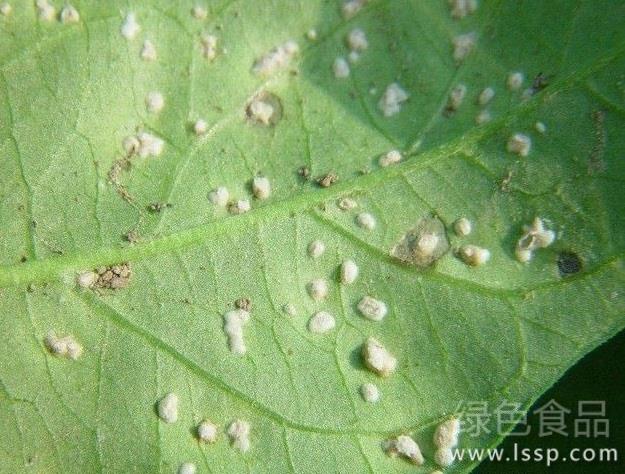
Amaranth white rust
1. The white rust pathogen mainly overwinters as oospores in the soil with amaranth diseased residues, and when conditions are suitable the following year, it produces sporangia or directly infects and causes damage. Continuous cropping year after year, low-lying terrain, poor drainage, easy water accumulation after rain, high planting density, and frequent flood irrigation all lead to severe disease.
2. Continuous rainy weather during the amaranth growing period, clear skies after rain, high temperature and high humidity, dense plant growth, and excessive application of nitrogen fertilizer alone make amaranth prone to white rust;
3. Amaranth white rust damages the leaves. In the early stage of the disease, yellowish spots appear on the upper surface of the leaves, light yellow-green to yellow dots, which later develop into sunken small yellow spots, irregular in shape. On the underside of the leaves, white blister-like spore masses are produced, round to irregular in shape. The blister-like spore masses rupture and release white sporangia. In severe cases, the blister spots are densely distributed on the leaves or merge together, making the leaves uneven, and easily causing leaf drop. When the stems are damaged, they become swollen and deformed, increasing in thickness by 1 to 1.5 times compared with normal stems.
Prevention and control methods for amaranth white rust
1. It is best to rotate with grass-family crops and other crops, and select disease-resistant varieties. If rotation is not practiced, before sowing, use 4000 grams per mu of Miaochuang Mimi (resistant to continuous cropping, seed dressing, can repel underground diseases and pests and isolate viral infection), which does not affect the imbibition function of germination, can strengthen soil respiration intensity, and improve the seed germination rate. At the same time, it is best to use drilling or ridge planting, strictly control the seeding rate and broadcasting density, which is helpful to prevent the occurrence of white rust.
2. Choose relatively flat fields that are not prone to water accumulation for cultivation, strengthen fertilizer and water management, and promote vigorous plant growth. In rainy seasons, drain field water promptly after rain, and plant appropriately sparsely.
3. During the amaranth growing period, thin out seedlings in time and remove overly dense seedlings to facilitate ventilation, drainage, and humidity reduction. Irrigate reasonably; small amounts of water applied frequently are preferable, and flood irrigation should be avoided. For base fertilizer, use formula fertilization, and pay attention to increasing the application of boron fertilizer, phosphorus fertilizer, and potassium fertilizer, avoiding excessive application of nitrogen fertilizer alone. Formula fertilization can enhance the stress resistance of amaranth, and promptly spray 150 milliliters of potassium dihydrogen phosphate, making amaranth stems thick and strong and leaves large and plump, improving the natural taste of amaranth.
4. Chemical control: from before the onset of amaranth white rust to the early stage of the disease, use 150 milliliters per mu of 58% Ridomil-MZ wettable powder, 60 milliliters of 60% Baitai (pyraclostrobin), or 150 milliliters of 64% Sandofan, mixed with 50 kilograms of water for uniform spray control, once every 5 to 7 days, for 2 to 3 consecutive times. Do not apply chemicals 7 to 10 days before harvest.