How to prevent and control heart rot in celery when outer leaves are dark green and inner leaves are dry, yellow and rotting
Main symptoms of celery "heart rot": the outer leaves of celery are dark green, and the inner leaves are dry, yellow and rotting. Heart rot can occur throughout the entire growth period of celery, and is most severe at the seedling stage. In mild cases, there are missing plants and reduced yield; in severe cases, the crop must be destroyed and replanted. The causes and control measures for the celery heart rot phenomenon are briefly described below:
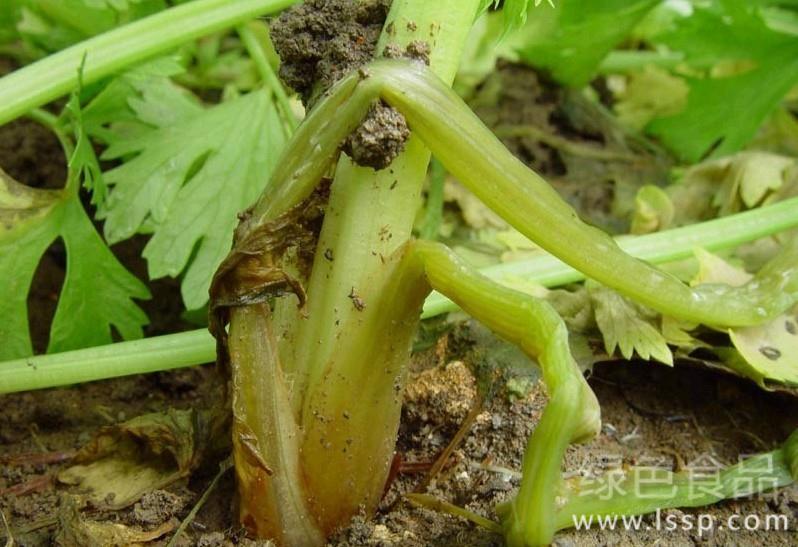
Celery heart rot
I. Causes of the disease:
1. Calcium deficiency. Due to high temperature, drought, improper fertilization, excessively high greenhouse temperature and lack of water, the absorption of calcium by the celery root system is hindered, causing heart rot; or excessive nitrogen, potassium and magnesium in the soil hinders the absorption of calcium by celery through antagonism.
2. Heart rot due to boron deficiency. The content of available boron in the soil is relatively low, or antagonism prevents celery from absorbing boron normally.
3. Bacterial soft rot. It mainly occurs at the base of the celery petiole or on the stem, appearing as water-soaked, light brown spindle-shaped or irregular sunken spots, which later become wet rot, turn black and give off a foul odor.
4. Sclerotinia rot. It first infects the base of the petiole near the ground and the root crown of celery. The affected parts appear water-soaked and rotten. When humidity is high, white mycelium can be seen, and later black sclerotia shaped like mouse droppings form.
II. Control measures
1. Grow strong seedlings. During seedling raising, thin the seedlings in time to promote thick and sturdy petioles and well-developed roots. Water reasonably to prevent excessive humidity. When the seedlings have 3-4 leaves, follow the principle of alternating dry and wet to promote root development. After transplanting and watering, subsequent watering should not be excessive.
2. Balance fertilization, and control temperature and soil moisture well to prevent physiological calcium deficiency in celery. It can be prevented by foliar spraying with a 0.3% calcium nitrate solution mixed with a 0.2% borax solution. At the same time, reduce the amount of nitrogen fertilizer used, especially ammonium nitrogen, and appropriately increase the amount of potassium fertilizer, which helps the absorption and utilization of calcium.
3. Chemical control.
(1) Bacterial soft rot: For control, use 72% agricultural streptomycin or Xinzhi streptomycin at 3000-4000 times dilution, 14% copper ammonia complex aqueous solution at 300 times dilution, 77% Kocide at 500 times dilution, or 47% Kasumin at 600 times dilution.
(2) Sclerotinia rot: Spray celery with 50% Vinclozolin at 1500 times dilution, 50% Procymidone at 1000 times dilution, 50% Duomeiling at 800 times dilution, 40% Dimethachlon at 800 times dilution, 50% Iprodione at 1000 times dilution, or 20% Kejunxing at 750 times dilution.