Pear trees rest and store nutrients in autumn, and low-yield orchards can be renovated to boost production
In autumn, pear trees rest and store nutrients. This is the season suitable for renovating low-yield pear orchards. After the pears are harvested, carry out orchard renovation to strive for high and stable yields the following year. The autumn renovation measures for pear orchards are briefly described below for farmers' reference.
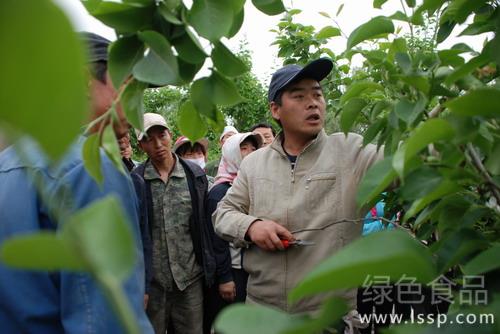
Pear tree shaping
1. Adjusting the tree structure:
If a pear tree shows conditions such as strong top growth and weak lower growth, numerous and tangled large branches, a tall and large canopy, dense outer branches, a hollow inner canopy, and fruiting shifted to the outer periphery, the pruning measures are as follows:
1. Suit measures to the tree and adjust the tree form. For the large branches retained as main and lateral branches but growing too tall and too long, carry out heading back in batches.
2. Reasonably thin out crossing branches and overlapping branches in the inner canopy, and remove dead branches, diseased and pest-infested branches, and thin weak branches.
3. For upright, thick, multi-year competitive branches growing on the upper side of main and lateral branches, if they are dense with no space, remove them from the base; if there is space on both sides, head them back to a lower branch.
4. For bare-legged branches with bare rear sections and weak lateral branches, head them back to vigorous positions to promote the growth of strong branches.
5. For drooping fruiting branch groups, head them back to a vigorous branching point to raise the branch tip. For spur groups in the inner canopy with too many and too dense branches, thin out the weak and keep the strong, remove upright ones and keep slanting ones, remove distant ones and keep near ones. After several years of pruning, ventilation and light penetration are achieved, the total branch volume and leaf area index tend to be reasonable, diseases and pests are reduced, and fruiting shifts from the outer periphery to three-dimensional fruiting inside and out.
2. Top grafting flowering branches:
To increase fruiting sites in the inner canopy and supplement pollinating pear trees, shoots sprouting from bare parts of scaffold branches can be used for top grafting flowering branches. Select 1-year-old flowering branches that are thick, plump, and have full buds from pear trees of the same cultivar or a pollinating cultivar, keep 2-4 buds, and top graft them in early spring using the cut grafting or cleft grafting method. According to surveys, the highest per-tree yield of top-grafted trees in the same year increased by 13 kg compared with the per-tree yield of non-top-grafted trees.
Pear tree disease and pest control
3. Disease prevention and pest control:
The main diseases of pear trees are pear scab, pear black spot, and others, and the main pests include pear aphids, pear psyllids, fruit borers, and slug moths. Thoroughly clean the orchard every winter and scrape off the loose bark on the trunk and large branches; before bud break, spray 3-5 degrees Baume lime sulfur mixture plus 500-fold sodium pentachlorophenate solution; from after bud break to before fruit ripening, according to the occurrence patterns of the main diseases and pests, spray a mixed fungicide and insecticide once every 10-20 days, for 4-6 sprays; in the late stage after fruit harvest, spray a mixed fungicide and insecticide with a long residual effect 1-2 times to prevent outbreaks of diseases and pests from causing early defoliation.
4. Scientific fertilization:
In late August, after the pears are harvested, apply 1-1.5 kg of special compound fertilizer for fruit trees per tree. In addition, combined with pesticide spraying, after the spring shoots unfold leaves, spray zinc sulfate plus magnesium sulfate 1-2 times; from the young fruit stage to after fruit harvest, spray monopotassium phosphate plus urea 3-5 times.