Strengthen fertilizer and water management and control pests and diseases in September for late rice to build a good high-yield seedling framework
Entering September, double-cropping late rice in the south will successively enter the young panicle differentiation stage. Due to more rain after transplanting this year's late rice, it is favorable for fish growth, and the growth is good. At this stage, it is necessary to control tillering and strengthen stems, strengthen fertilizer and water management to increase the earing rate, promote large panicles and more grains, and at the same time control the fourth generation of rice stem borer, fifth generation of leaf roller, and sixth generation of rice planthopper, etc., to build a good seedling framework for high yield of late rice.
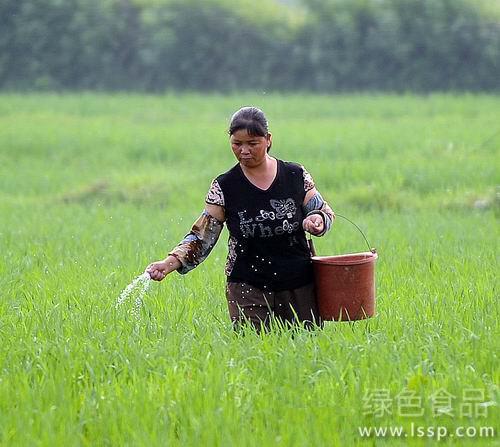
Fertilization of late rice
1. Implement classified guidance. This year there are many late rice varieties, the transplanting seasons are inconsistent, and the growth progress differs greatly. It is necessary to adapt measures to local conditions, do a good job in classifying seedling conditions, and implement classified guidance. For late rice fields that have passed the tillering stage, quickly drain and sun the field to control ineffective tillering, so as to build a good seedling framework for sufficient ears and larger panicles; for late-transplanted fields, because the seedling age is long, the seedlings are aged, the seedling quality is relatively poor, and tillering is slow and short in duration, apply tillering fertilizer early and heavily to speed up tillering; for second-class seedlings, quickly apply quick-acting fertilizer as a supplement to allow balanced growth, and at the same time combine with field drying, and field drying must go from light to heavy; for third-class seedlings with weak growth vigor, analyze the reasons, apply the right remedy, and promote the transformation of seedling conditions; for low-lying waterlogged plots, drain water and aerate to promote roots, topdress quick-acting fertilizer, and supplement with manual intertillage; for plots that were transplanted late and have not passed the tillering stage, manage carefully and meticulously, spray on the leaves (potassium dihydrogen phosphate) and promote below (topdress quick-acting fertilizer), to promote early passage through the tillering stage.
2. Scientific water management. Late rice is sensitive to water from young panicle differentiation to before heading. Long-term waterlogging will damage the roots. If there is long-term water shortage and drought, it will affect young panicle development, cause degeneration of spikelets, reduce grains per panicle, and lower yield. Therefore, in mid-season field management, scientific water use should be promoted, maintaining soil moisture in the form of intermittent irrigation with “horse-racing water”. Fields with enough seedlings should be sunned in time to reduce ineffective tillering and increase the earing rate. In addition to looking at seedling conditions, field sunning should also depend on the weather, water sources, and varieties, so that when there are enough seedlings one does not wait for the time, and when the time comes one does not wait for the seedlings. It is required that before applying differentiation fertilizer, all fields must pass through the field-sunning stage, so as to achieve the purpose of nourishing roots with air, protecting leaves with roots, and increasing grains with leaves.
3. Apply differentiation fertilizer well. In September, late rice successively enters the young panicle differentiation stage. Seize the opportunity to apply differentiation fertilizer, and at the same time pay attention to fertilization techniques, striving for more panicles, larger panicles, and a higher seed-setting rate. In applying differentiation fertilizer, first look at the seedlings: after field drying, the rice seedlings turn from black to yellow, and 2-3 days before young panicle differentiation, quickly apply differentiation fertilizer; second, look at the field: for late rice fields with fertile soil, excessive growth, and poor field-sunning effect, apply differentiation fertilizer lightly or temporarily, and later apply supplementally as appropriate according to the yellowing condition. Generally, apply 5-7 kg of urea plus 5-7 kg of potassium chloride or 10-15 kg of compound fertilizer per mu, and decide the nitrogen fertilizer application rate according to the specific seedling conditions. When applying differentiation fertilizer, there should be a shallow water layer in the field. After application, let the water layer dry naturally. If ear fertilizer is applied early, it can be exposed for a few more days; after the water layer dries after late application, irrigate a shallow water layer again.
Pest and disease control of late rice
4. Pest and disease control. The main pests and diseases of late rice: rice blast, sheath blight, bacterial leaf blight, fine stripe disease, rice leaf roller, striped stem borer, yellow stem borer, rice planthopper, etc. Pay close attention to the dynamics of pest and disease occurrence, do a good job in forecasting and prediction, and take timely measures to reduce pest and disease damage. To control rice blast, use Fuji No. 1, Kasumin, prochloraz, tricyclazole, Hinosan, etc.; to control sheath blight, use Amistar, validamycin, Wenbingqing; to control bacterial diseases such as bacterial leaf blight and fine stripe disease, use Yeshuangqing, Longkejun, Mengkejun and other agents; to control rice leaf roller, striped stem borer, yellow stem borer, rice planthopper, etc., use Fogo, Kangkuan, or (Huo Fenghuang, Lanrui, Yinnong No. 1) plus acetamiprid, buprofezin, etc.