Autumn-delayed melons enter a critical period in September; how can they be managed for high returns?
At present, it is the critical period for managing autumn-delayed melons. Combining production practice, the cultivation and management techniques for autumn-delayed melons are summarized as follows:
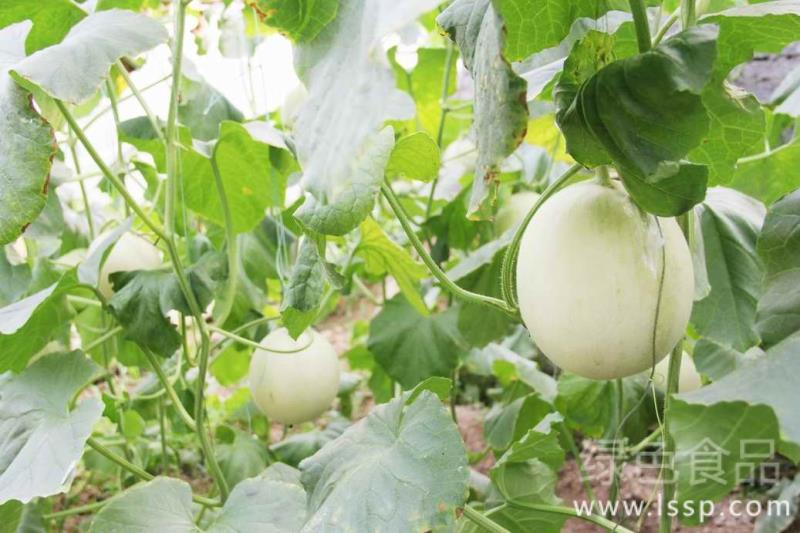
Melon
I. Integrated fertilizer and water management
At present, the melons are in the vine-extension stage, and there must be a certain level of soil water-holding capacity, suitably maintained at 60%-70%. The subsequent fruit-swelling stage is the period of greatest water demand in the entire growth cycle of melons, so watering should be increased to bring soil water-holding capacity to 80%-85%. When fruit swelling ends and the plants enter the ripening stage, watering should be controlled to favor sugar accumulation. Fertilizer should be applied together with watering, using water to carry fertilizer, so as to maintain a balanced supply of fertilizer and water. For topdressing, humic acid and bio-organic fertilizer should be applied, with 25 kg-30 kg per mu each time; during the fruit-swelling stage, high-potassium fertilizer should be heavily applied, with 15 kg-20 kg per mu each time.
II. Control temperature, reduce humidity, and increase the temperature difference
During the stem and leaf growth period of melons, daytime temperatures should be 25°C-30°C and nighttime temperatures 16°C-18°C, with a day-night temperature difference of 10°C-13°C being most suitable. During the fruiting period, daytime temperatures should be 28°C-30°C and nighttime temperatures 15°C-l8°C, with a day-night temperature difference above l3°C being preferable, and sufficient sunlight is also required. In addition, the relative air humidity should be reduced by opening and closing the greenhouse vents, with air humidity suitably at 60% during the day and 70%-80% at night.
III. Rational pruning and side-shoot removal
For autumn-delayed cultivation of thick-skinned melons, single-vine pruning is adopted. Generally, on a sunny day, all secondary vines below the 10th node of the main vine should be promptly removed, and secondary vines at the 11th-13th nodes should be retained as fruiting branches, pinched at 2 leaves. After the fruit is set, the vine should be topped at the 22nd-25th leaves, and secondary vines growing from each leaf axil, as well as old leaves and diseased leaves on the lower part of the plant, should be removed early and taken out of the greenhouse for timely disposal.
IV. Hand pollination and fruit retention
Flowering generally occurs in early to mid-September. For each plant, select 2 adjacent female flowers, and within 1 hour to 2 hours after each female flower opens, carry out hand pollination flower-to-flower, or 1 day to 2 days before the female flower opens, dip the flower in forchlorfenuron solution to promote fruit set. About 1 week after pollination, when the young fruit is the size of an egg, retain 1 young fruit with a regular shape and relatively large size per plant as the commercial melon. If the young fruit's growth and development are not ideal enough or the flowering period encounters unfavorable weather such as continuous overcast rain, pollination and fruit retention can be postponed in sequence to ensure quality.
Pest and disease control in melons
V. Pest and disease control
Adhere to the principles of giving priority to agricultural control, physical control, and biological control, with chemical control as a supplement, and of prevention first and integrated control. During the growth period of autumn-delayed melons in greenhouses, the main insect pests are aphids and whiteflies, and the main diseases are powdery mildew, downy mildew, gray mold, bacterial angular leaf spot, viral diseases, and so on.
For the control of aphids and whiteflies, 30-40 yellow sticky traps per mu should be hung 10 cm above the plant growing points, and for pesticides, 10% imidacloprid 1500x solution, bifenthrin 500x solution, Jinjier AB 500x solution, etc. can be used for alternating foliar spraying.
For powdery mildew, 37% difenoconazole 10000x solution or 75% chlorothalonil 500x solution can be used for spraying; for downy mildew, 72% cymoxanil mancozeb 500x solution, 80% dimethomorph 2000x solution, or 72% propamocarb hydrochloride 1000x solution can be used for spraying; for gray mold, 72% Kelu wettable powder 500x-600x solution or 64% Sandofan wettable powder 500x solution can be used for spraying; for bacterial angular leaf spot, 72% agricultural streptomycin 1500x solution, 53.8% copper hydroxide 1000x-1500x solution, 50% copper succinate-glutarate wettable powder 500x solution, or 15% tetramycin 600x solution can be used for spraying; for viral diseases, 20% moroxydine copper acetate 1000x solution, 4% ningnanmycin 500x solution, 4% pyrimidine peptide mycin 500x solution, and other pesticides can be used for spraying. When foliar spraying on melons is inconvenient on rainy days, smoke agents such as isoprocarb and chlorothalonil can be used to fumigate the greenhouse.