Field management of Welsh onion in the mid-to-late stage: watering, topdressing and earthing up to increase yield
After the End of Heat (Chushu) period, when the average daily temperature drops below 24°C until before Frost's Descent (Shuangjiang), during the vigorous growth period of Welsh onion, on average 1 leaf can grow every 7 to 8 days; the higher the leaf order, the larger the leaf, and the longer the leaf lifespan. During this period, because the weight of the leaf blade and the white stalk (pseudostem) increases rapidly, the water requirement increases; combined with topdressing and earthing up, water should be applied once every 4 to 5 days, and the amount of water should be large.
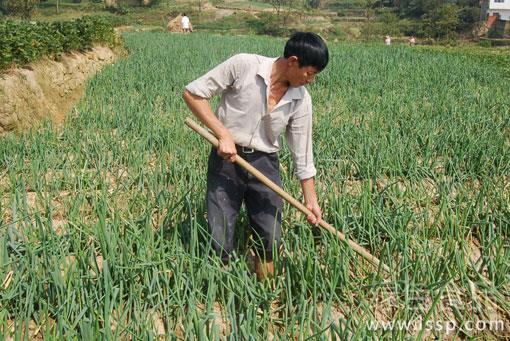
Earthing up of Welsh onion
I. Watering:
Water-retaining ridges should be built in the Welsh onion furrows, and the water in each furrow should be applied sufficiently and evenly. If there is drought and little rain, and the watering amount is insufficient, the growth of the white stalk and the yield of Welsh onion will be affected. Generally, high-yield plots need to be watered 8 to 10 times at this stage. After Frost's Descent (Shuangjiang), the temperature drops, and Welsh onion basically enters the filling period of the pseudostem (white stalk). Welsh onion grows slowly and its water requirement decreases, but the soil still needs to remain moist, so that the pseudostem can fill out, the leaf mesophyll becomes thick and full of gel, and the white stalk becomes fresh, tender and plump. During this period, 2 waterings are needed to meet the requirement. If water is lacking, the Welsh onion leaves will wither and soften, the white stalk will be loose, the yield will decrease, and the quality will deteriorate. Stop watering 7 to 10 days before harvest to facilitate harvesting, storage and transportation.
II. Topdressing:
Timely topdressing can achieve high yield and high quality of Welsh onion. Topdressing for Welsh onion should be carried out in stages. ① Early stage of white stalk growth: just after the hot summer, when the weather turns cool, the onion plants grow faster; apply 1 leaf-promoting fertilizer, with 1000 to 1500 kg of decomposed farmyard manure, 100 kg of plant ash, and 15 to 20 kg of superphosphate per mu, then water once, which can promote the growth of Welsh onion and increase and lengthen the leaves; ② Vigorous growth stage of the white stalk: the key period for Welsh onion yield formation, when the onion plants rapidly grow taller and the white stalk thickens, requiring large amounts of water and nutrients. Apply plant-promoting fertilizer in 2 to 3 applications, with equal emphasis on nitrogen, phosphorus and potassium. For the first application, decomposed farmyard manure plus heated soil can be applied at 4000 to 5000 kg plus 15 to 20 kg of potassium sulfate, applied on both sides of the onion rows, followed by cultivation, earthing up and watering. The latter two topdressings can be broadcast between the rows with 15 to 20 kg of ammonium sulfate or urea, followed by shallow cultivation and watering, to meet the needs of the rapid growth of Welsh onion.
III. Earthing up:
Earthing up can soften the leaf sheaths, prevent lodging, and improve the yield and quality of the white stalk. When Welsh onion is given enhanced fertilizer and water supply while being earthed up, the pseudostem can be softened, the length of the white stalk extended, and the quality of the white stalk improved. Generally speaking, the higher the earthing up, the longer the white stalk, and the tissue of the white stalk is also whiter and plumper. After Welsh onion enters the vigorous growth period, as the leaf sheaths lengthen, timely inter-row cultivation should be carried out and earthing up should be done in stages, so that the original ridge backs become furrows and the onion furrows become ridges. The height of each earthing up depends on the growth height of the pseudostem, and is 3 to 4 cm; earth should be piled up to the boundary between the leaf sheath and the leaf blade of the Welsh onion, that is, only bury the leaf sheath, not the leaf blade, so as to avoid causing the leaves to rot. From the Start of Autumn (Liqiu) to harvest, generally 3 to 4 earthing up operations are carried out.
When earthing up, also note: First, the width of soil taken should not exceed 1/3 of the row spacing width and 1/2 of the furrow depth, so as to avoid damaging the roots and affecting the development of the Welsh onion root system. Second, after earthing up, the soil on both shoulders of the Welsh onion ridge should be patted firm to prevent collapse caused by rain washing or watering.