The Asian citrus psyllid is the only vector of citrus greening disease (Huanglongbing); how should it be controlled?
The Asian citrus psyllid is the only natural vector of citrus greening disease (Huanglongbing), so strict control of the Asian citrus psyllid over a large area is the most important measure for preventing and controlling citrus greening disease.
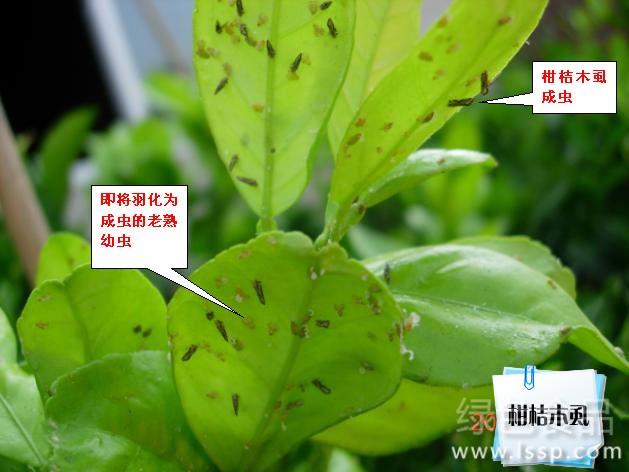
Asian citrus psyllid
The Asian citrus psyllid has four characteristics in transmitting the disease: First, the transmission rate is high, with a single adult reaching a transmission rate of 70-80%; second, it carries the pathogen for life - once a nymph acquires the citrus greening pathogen, it does not disappear with molting, and the nymph at the next instar or the adult still carries the greening pathogen; third, it spreads with the wind, as adults can fly 7 m high and spread short distances with the wind; fourth, it transmits the pathogen rapidly. These characteristics determine that to control citrus greening disease, the psyllid must be killed quickly and effectively.
Control of the Asian citrus psyllid should focus on prevention and should not wait until psyllids are found to spray. If spraying is only done when psyllids are found in the citrus orchard, the psyllids have likely already transmitted citrus greening disease. At present, control of the Asian citrus psyllid relies mainly on fast-acting, highly effective chemical control, supplemented by agricultural, biological and physical control.
Spraying chemical pesticides is still the most important measure for controlling the Asian citrus psyllid. Winter orchard cleanup and the new shoot flushing periods in spring, summer and autumn are the key times for spraying. Psyllids feed only on tender shoots, and the shoot-flushing period is the high-risk period for psyllids. Winter orchard cleanup can kill overwintering adult psyllids and reduce the spring population base, making it the most critical period for controlling the Asian citrus psyllid throughout the year. During the new shoot flushing period, when new buds are 0.5-1.0 cm long, spray for control, and as the new shoots grow, spray again after about 5-10 days. The main pesticides include 21% thiamethoxam aqueous suspension concentrate at 3500 times dilution, 25% quinalphos emulsifiable concentrate at 1000 times dilution, 4.5% bifenthrin emulsion in water at 1500 times dilution, 2.5% beta-cyfluthrin emulsion in water at 1500 times dilution, 51.5% beta-cypermethrin · chlorpyrifos emulsifiable concentrate at 1000 times dilution, etc.
It is worth noting that before cutting down and digging out citrus greening-diseased trees, psyllid adults must first be killed by spraying, to prevent disease-carrying psyllids from hiding on healthy trees. After fruit harvest, orchard cleanup should be carried out immediately to kill psyllids. Psyllids should also be killed promptly after typhoon rain or heavy rain. Adult Asian citrus psyllids can migrate over long distances. During the typhoon rain season and strong convective weather (May to September), adult psyllids from areas with severe citrus greening disease in the southeast are lifted by the wind and migrate passively over long distances. Adult psyllids from neighboring citrus greening orchards are also lifted by strong winds and fly into orchards, so after typhoon rain and heavy rain, spraying to kill psyllids should be carried out immediately when the weather clears.
In addition, auxiliary measures such as agricultural and physical control can also be used, such as clearing psyllid host plants such as orange jasmine (Murraya paniculata) and wampee (Clausena lansium) around the citrus orchard. Through pruning, fertilization and irrigation, promote uniform and consistent new shoot flushing in citrus, shorten the shoot-flushing time, and promote the maturation of new shoots.