Walnut bacterial blight causes leaves to turn black and drop and fruit to rot. How can it be controlled?
Walnuts are currently in the early stage of maturity, and walnut trees have a relatively high demand for nutrients. However, the north has generally entered the rainy season. If the walnut orchard has poor ventilation and light penetration, diseases are likely to develop, especially walnut bacterial blight.
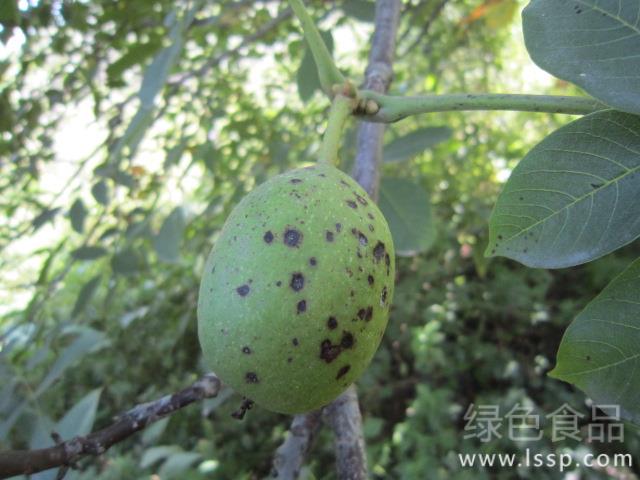
Walnut bacterial blight
1. Disease symptoms
Walnut bacterial blight, also known as black rot, mainly damages young fruit and leaves, and can also damage young shoots. When young walnut fruit is infected, small brown spots appear on the fruit surface with indistinct edges, which later merge and turn black, penetrating deep into the flesh, causing the entire walnut to turn black or rot and drop off; when nearly mature walnuts are infected, the disease first affects the outer husk and then spreads to the middle husk, causing the diseased part of the husk to fall off and the inner shell to be exposed, while the kernel remains intact; when leaves are infected, small brown spots that are nearly round or polygonal appear on the veins. After expansion, they merge with one another, and a water-soaked halo appears around the lesions. In the later stage, a few perforations form, and the diseased leaves shrink and become deformed. In severe cases, the entire leaf turns black, becomes brittle, and drops.
2. Occurrence pattern
The pathogenic bacteria overwinter in the twigs or buds of walnut trees. The bacterial fluid secreted the following year is spread by wind and rain, invading through host stomata, lenticels, nectar glands, and wounds, causing infection of leaves, fruit, or young shoots. At 4-30°C, with a moist host epidermis, the pathogen can invade leaves or walnuts. The field incubation period is 10-15 days. Walnut trees are susceptible to infection during the flowering and leaf expansion stages, and disease is severe in summers with frequent rain. Wounds caused by damage from the walnut shoot borer are highly susceptible to infection by this bacterium.
3. Key control points
(1) Agricultural control: apply more organic fertilizer, irrigate and drain reasonably, cultivate strong trees, and improve the disease resistance of walnut trees; in summer, pay attention to drainage and cleaning in the walnut orchard to maintain good ventilation and light penetration.
(2) Chemical control: during the leaf expansion stage and after flower drop of walnut trees, spray 72% agricultural streptomycin soluble powder at 3000 times dilution, or 50% thiram wettable powder at 800 times dilution, or 75% chlorothalonil wettable powder at 600 times dilution, etc. In addition, pests such as the walnut shoot borer should be controlled in time to reduce wounds.