Apple tree canker causes weakened tree vigor, dead branches and even tree death; how to prevent and control it
Apple tree canker, commonly known as bark rot or smelly bark disease, is one of the main diseases of apple trees. This disease harms fruit-bearing trees, causing weakened tree vigor and dead branches, and in severe cases tree death and orchard destruction.
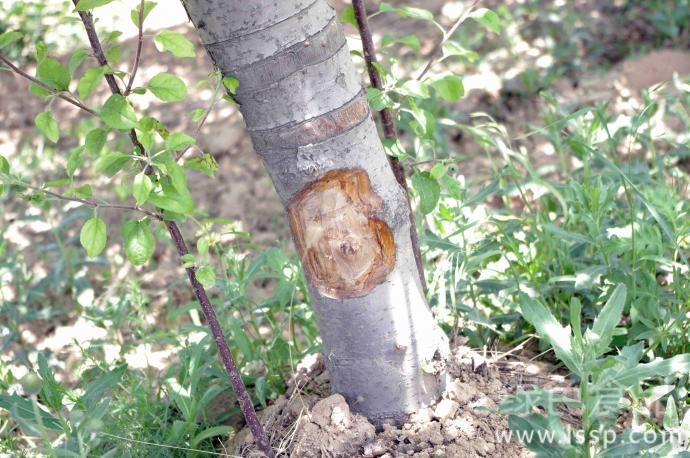
Apple tree canker
Symptoms: Apple tree canker mainly harms the trunk and main branches, and also harms small branches, young branches and fruit. Based on branch symptoms, it is divided into the canker type and the branch-blight type. Canker type: occurs on the trunk and main branches; the diseased bark shows reddish-brown water-soaked slightly raised round to oblong lesions, the diseased part is soft and easily torn, sunken when pressed by hand, exudes yellow-brown sap, has a strong distiller's grains smell, then gradually loses water and shrinks, cracks form at the edges, and small black dots appear. When humid, the small black dots can exude yellow-brown tendril-like matter. Branch-blight type: occurs on 2-5 year old branches; the lesion edges are unclear, not raised, not water-soaked; the infected branch loses water and dries up, small black dots gradually form on the lesion, and in severe cases it harms the apple, causing light brown rot with a distiller's grains smell.
Disease pattern: Apple canker has two peak periods each year, March-April and July-September. In early spring, as temperatures rise, sap begins to flow, nutrients move toward the growing points, the trunk and branches have few nutrients, and together with warming on the sunny side of the tree, nutrient imbalance occurs, the apple tree's disease resistance decreases, causing lesions to expand and spread, forming the spring disease peak. Then the lesions expand rapidly, causing severe damage, often resulting in dead branches and dead trees. In May-June, the tree has luxuriant branches and leaves, nutrients begin to accumulate in the branches, the tree's disease resistance strengthens, and lesions stop expanding. In July-September, the apple rapidly expands and needs a large amount of nutrients, tree nutrients decrease, lesions begin to expand, and an autumn peak appears. It can be seen that tree vigor strength can affect the severity of canker. Unbalanced tree nutrition, excessive fruiting, too many wounds, severe freeze injury, fertilizer deficiency, drought, early defoliation, and major outbreaks of spider mites make canker more severe.
Control measures:
Strengthen cultivation management: apply more organic fertilizer, phosphorus fertilizer and potassium fertilizer, and fertilize in a balanced way; do well in flower and fruit thinning, control the fruit load, and prevent alternate bearing in apples; irrigate in spring and control water in autumn, and irrigate reasonably; reduce and protect wounds, and apply 843 rehabilitation agent to pruning and saw cuts; strengthen pest and disease control to avoid early defoliation of apple trees; after leaf fall in early winter, make a whitewash from quicklime, 20 Baume degree lime sulfur mixture, salt, animal oil and clean water in a ratio of 6:1:1:0.1:10 and apply it to the trunk; promptly prune diseased branches, scrape off lesions and old cracked bark, take them out of the orchard, and destroy them centrally. Chemicals to kill the pathogen: spray the whole tree once with 3-5 Baume degree lime sulfur mixture before bud break in early spring. Timely treatment of lesions: first, mud wrapping. Mix clay with an appropriate amount of water into sticky mud, apply it 3-5 cm thick on the lesion, the mud layer should extend 4-5 cm beyond the outer edge of the lesion, then wrap it with plastic sheeting and tie it tightly. Second, cutting treatment. Use a knife to cut a ring 1 cm outside the edge of the lesion, with the cut reaching the xylem, and make several crisscross cuts on the lesion reaching the xylem, then apply 843 rehabilitation agent or 21% peracetic acid aqueous solution at 2-5 times dilution, and the applied edge should extend 3 cm beyond the outer edge of the lesion. After 1 month, apply again once. Third, scraping treatment. Use a sharp knife to scrape off the lesion reaching the xylem, and scrape off 0.5-1 cm of healthy bark at the edge of the lesion, then apply 5% Jun Du Qing aqueous solution at 30-50 times dilution or 843 rehabilitation agent stock solution. This disease easily recurs, so inspections should be made promptly in summer and autumn. Fourth, bridge grafting. Large scars on the trunk of apple trees can be bridge grafted in time. Generally in spring, choose 1-year-old vigorous branches as scions, and bridge graft at the upper and lower edges of the lesion; when the lesion is large, multiple-branch bridge grafting can be carried out. In addition, sprouting buds can also be used for foot grafting.