Post-harvest management measures for early-maturing apples: topdressing, pruning, sowing grass, and pest and disease control
After early-maturing apples are harvested, it is an important stage for apple leaves to carry out photosynthesis and store nutrients for the apple trees, and also an important period for pest and disease control. In production, failure to bear fruit after flowering, many flowers but few fruits, severe physiological fruit drop, and small or deformed fruits are all closely related to insufficient stored nutrients in apple trees and post-harvest pests and diseases. Therefore, after harvest, pruning, fertilization, and pest and disease control should be carried out in a timely manner, so as to restore tree vigor, increase nutrient accumulation, reduce overwintering pests and diseases, and lay the foundation for flowering and fruiting and high-quality production the following year. The specific measures are as follows:
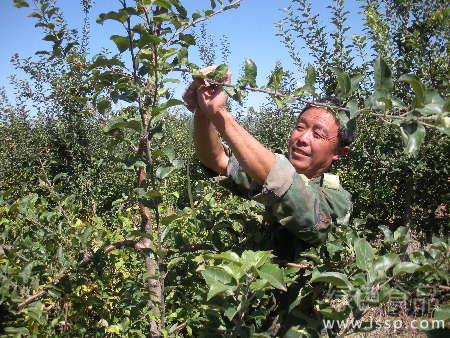
Apple pruning
Post-harvest pruning:
Prune apple trees promptly after harvest to control shoot growth and promote strong trees. Pruning mainly consists of thinning branches, heading back, pinching, and strong branch bending. Promptly cut off upright, useless vigorous branches, multi-headed competitive nutrient-draining branches, and pest- and disease-damaged branches; appropriately head back weakened branches after fruiting; for vigorous branches with growth space, pinching and twisting can be used; for those with unsuitable angles, bend the branches, so that the apple trees have good ventilation and light penetration, save nutrients, reduce consumption, and promote flower bud differentiation.
Fertilizer and water management:
Fruit trees consume a large amount of nutrients during flowering and fruiting, causing the apple trees to weaken. After the apples are harvested, promptly supplement quick-acting nitrogen, phosphorus, and potassium fertilizers, apply more organic fertilizer, and provide appropriate water. Fertilizing at this time, when soil temperature is relatively high, microorganisms decompose quickly, and root absorption is strong, can quickly supplement nutrients to the apple trees and accumulate nutrients for high-quality production the following year. The amount of fertilizer applied accounts for about 60% of the annual fertilizer amount. The annual fertilizer amount for apple trees should be determined according to tree age, tree vigor, yield, and fertilizer type. The overall principle is that to produce 100 kg of apples, 100-200 kg of farmyard organic fertilizer, 1 kg of pure nitrogen, 0.5 kg of pure phosphorus, and 1 kg of pure potassium are needed.
Pest and disease control:
The purpose of controlling pests and diseases after apple harvest is to ensure healthy growth of apple leaves. Apple leaves are the nutrient factory of apple trees. The tree depends on leaves for nourishment, and the fruit depends on leaves for growth. Protecting leaves is especially important. During this period, it is necessary to prevent and control brown spot disease, anthracnose, ring rot, rot disease, fruit borers, red spiders, leaf miners, and so on. If control is not timely, it will harm the apple trees and lead to early defoliation. Therefore, apply the right remedy according to the pest and disease situation. Fungicides can include thiophanate-methyl, polyoxin, Bordeaux mixture, Daconil M-45, mancozeb, and so on. Insecticides and acaricides can include Kung Fu, diflubenzuron, Taoxiaoling, abamectin, and so on. For rot disease, after scraping off the diseased spots, apply 50-100 times diluted jun du qing or humic acid copper-based healing agents.
Sowing grass in the orchard:
In no-till apple orchards, after harvest, white clover, alfalfa, and so on can be planted, which can improve the soil, build up soil fertility, regulate orchard temperature and humidity, and enhance soil permeability. At the same time, it fixes nitrogen from the air and reduces the amount of chemical fertilizer used. Eliminating soil tillage is a new technology suited to simplified management.