What kind of pesticide is acephate? Detailed explanation of its action and uses
What is acephate? Please give an introduction to acephate: Other name Orthene. Toxicity: Acephate is a low-toxicity insecticide. The oral LD50 of the technical material in rats is 945 mg/kg, the dermal LD50 in rabbits is 2000 mg/kg, and no lesions were found in beagles fed 1000 mg/kg daily for 1 year...
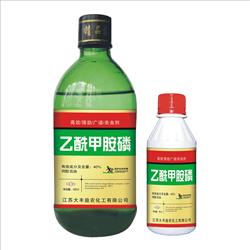
What is acephate? Please give an introduction
Acephate:
Other name Orthene
Toxicity: Acephate is a low-toxicity insecticide. The oral LD50 of the technical material in rats is 945 mg/kg, the dermal LD50 in rabbits is 2000 mg/kg, and no lesions were found in beagles fed 1000 mg/kg daily for 1 year; the oral LD50 in chicks is 852 mg/kg; the TLM for crucian carp is 9550 mg/kg, for silver carp (48H) 485 mg/kg, and for red carp TLM (48h) 104 mg/kg.
Formulations: 1% Shennong cockroach bait, 30% and 40% acephate emulsifiable concentrate, 25% acephate wettable powder, 75% acephate soluble powder.
Characteristics: Acephate is a systemic insecticide with stomach-poison and contact action, and it can also kill eggs, with a certain fumigant effect. It is a slow-acting insecticide, and its basic insecticidal principle is inhibiting insect acetylcholinesterase. It is suitable for vegetables, tobacco, fruit trees, cotton, citrus, rice, and wheat, to control various chewing and piercing-sucking pests and pest mites. If mixed with pesticides such as carbaryl and dimethoate, it has a synergistic effect and can prolong the residual period.
Scope of application: It is suitable for crops such as vegetables, tea trees, tobacco, fruit trees, cotton, rice, wheat, and rapeseed, to control various chewing and piercing-sucking pests and pest mites as well as sanitary pests.
Methods of use
1. Control of vegetable pests: For cabbage caterpillar, control is carried out at the 2nd-3rd instar larval stage; for diamondback moth, control is carried out at the peak outbreak stage of 1st-2nd instar larvae. Use 80--120 mL of 30% emulsifiable concentrate per mu, diluted with 40--50 kg of water for spraying. For aphids, use 50--70 mL of 30% emulsifiable concentrate per mu, diluted with 50--75 kg of water for uniform spraying.
2. Control of rice pests: For rice leaf roller, use 125--225 mL of 30% emulsifiable concentrate per mu, diluted with 60--75 kg of water for spraying. For rice planthopper, use 80-150 mL of 30% emulsifiable concentrate per mu, diluted with 60--75 kg of water for spraying.
3. Control of cotton pests: For cotton aphid, use 100--150 mL of 30% emulsifiable concentrate per mu, diluted with 50--75 kg of water for spraying. For cotton bollworm, mainly control the 2nd and 3rd generation larvae in cotton fields; for pink bollworm, the suitable control period is the peak moth emergence and egg-laying stage of each generation. The dosage for both is 150--200 mL of 30% emulsifiable concentrate per mu, diluted with 75--100 kg of water for conventional spraying.
4. Control of fruit tree pests: For peach fruit borer and pear fruit borer, control is carried out at the peak adult egg-laying stage, using 30% emulsifiable concentrate diluted 500-750 times for uniform spraying. For citrus scale insects, the best control effect is at the 1st instar nymph stage, using 30% emulsifiable concentrate diluted 300-600 times for uniform spraying.
5. Control of pests of dryland grain crops: To control armyworm on corn and wheat, before the 3rd instar larvae, use 120-240 mL of 30% emulsifiable concentrate per mu, diluted with 75--100 kg of water for spraying.
6. Control of tobacco pests: To control tobacco budworm, at the 3rd instar larval stage, use 100--200 mL of 30% emulsifiable concentrate per mu, diluted with 50--100 kg of water for spraying.
Precautions
1. The safe interval for this product on vegetables is 7 days, and 9 days in autumn and winter, with a maximum of 2 uses per season; the safe interval for rice, cotton, fruit trees, citrus, tobacco, corn, and wheat is 14 days, with a maximum of 1 use per season.
2. Spray evenly on the surface during use to help improve efficacy.
3. Wear protective equipment when handling this product. When spraying, stand upwind, wear a mask, and do not inhale the droplets. After use, wash thoroughly with soap and clean water.
4. This product should not be used on mulberry or tea trees.
5. This product must not be mixed with alkaline agents to avoid decomposition and loss of efficacy.
6. This product is flammable, and open flames are strictly prohibited. Pay attention to fire prevention during transportation and storage, and keep away from ignition sources.
Poisoning first aid:
Poisoning symptoms: Mild poisoning: headache, dizziness, nausea, vomiting, excessive sweating, weakness, chest tightness, blurred vision, poor appetite, etc. Whole blood cholinesterase generally drops below 70% of the normal value. Moderate poisoning: in addition to the above symptoms, there are also mild difficulty breathing, muscle tremors, constricted pupils, mental confusion, unsteady walking, heavy sweating, salivation, abdominal pain, diarrhea, etc. In severe cases, there may also be coma, convulsions, difficulty breathing, foaming at the mouth, incontinence of urine and feces, seizures, and respiratory paralysis. Acute poisoning usually develops within 12 hours, and in cases of accidental ingestion, symptoms may develop immediately. First aid measures: If accidentally inhaled, move the patient to a well-ventilated place. If accidentally contacted with skin or splashed into eyes, rinse with plenty of clean water for at least 15 minutes. If accidentally ingested, immediately take the patient to the hospital for diagnosis and treatment along with this label.
[1] Inject atropine 1-5 mg subcutaneously or intravenously (depending on the severity of poisoning);
[2] Inject pralidoxime 0.4-1.2 g intravenously (depending on the severity of poisoning);
[3] Morphine, theophylline, phenothiazines, and reserpine are prohibited.
[4] In case of accidental ingestion, immediately induce vomiting, gastric lavage, and catharsis (vomiting can only be induced when conscious).
Storage and transportation:
This product should be stored in a dry, cool, well-ventilated, rainproof place, away from ignition sources or heat sources. Keep out of reach of children and lock it up. Do not store or transport it together with food, seeds, beverages, feed, or flammable and explosive materials. Used containers should be properly disposed of, must not be reused for other purposes, and must not be discarded at will.
Click to get more insecticide application techniques
Click to get more pesticide application techniques