What kind of pesticide is monosultap, and which pests can it control?
Monosultap, also called shachongdan or monosodium salt, is a nereistoxin-type insecticide whose chemical structure is extremely similar to that of bisultap. That is, bisultap is a disodium salt, while monosultap is a monosodium salt; therefore its insecticidal characteristics and target pests are the same as those of bisultap, and its application methods and precautions are also the same as those of bisultap. Because monosultap...
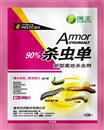
Monosultap, also called shachongdan or monosodium salt, is a nereistoxin-type insecticide whose chemical structure is extremely similar to that of bisultap. That is, bisultap is a disodium salt, while monosultap is a monosodium salt; therefore its insecticidal characteristics and target pests are the same as those of bisultap, and its application methods and precautions are also the same as those of bisultap. Because the relative molecular mass of monosultap is smaller than that of bisultap, at the same dose the number of molecules of monosultap is greater than that of bisultap, so its efficacy is somewhat better. Products include 90% technical powder, 3.6% granules, and 36%, 45%, 50%, 80%, 90%, 92%, 95% soluble powders, and 20% microemulsion.
Pests that monosultap can control:
For rice, to control the striped stem borer and the yellow stem borer, at the peak of egg hatching use 40-50 grams of 90% soluble powder per mu, spray as a coarse mist with 75-100 kg of water or splash-apply with 200-300 kg of water, or use 1-1.4 kg of 3.6% granules per mu, mixed with fine soil and broadcast. During application, keep the field water at about 5 cm, and apply again after 10 days.
To control the rice striped stem borer, rice green leafhopper, rice leaf roller with clear markings, rice leaf roller, rice white-winged leafhopper, rice skipper, rice thrips, etc., at the peak of 2nd-3rd instar larvae, use 30-50 grams of 90% technical powder per mu, or 70 grams of 80% soluble powder per mu, spray with 50-75 kg of water; adding 0.05%-0.1% washing powder to the spray liquid can improve the control effect.
Sugarcane borers use 160 grams of 90% technical powder per mu, apply to the root zone, and keep the sugarcane field moist so that the pesticide can be absorbed and take effect; the pre-harvest interval is at least 28 days.
Cabbage caterpillar, diamondback moth and soybean hawk moth use 30-40 grams of 90% technical powder per mu; to control cabbage aphid, use 75-100 milliliters of 20% microemulsion per mu, with 40-60 liters of water, and add 15-20 milliliters of detergent or 885 adjuvant, and spray.
Tea leafhopper: before the peak occurrence of tea leafhopper nymphs, use 50-75 grams of 90% soluble powder per mu, with 50-75 kg of water (1,000-fold solution), and spray over the bush surface.
Citrus leafminer: after the summer and autumn shoots sprout, spray with a 2,000-fold solution of 80% soluble powder. To control grape stem borer, spray with a 2,000-fold solution of 80% soluble powder before the grapes flower.
Precautions:
Monosultap is toxic to silkworms and must not be used to control pests in mulberry fields. When used in rice fields near mulberry fields, special attention must be paid to wind direction, and mulberry leaves must absolutely not be contaminated so as to cause silkworm poisoning. Use should be stopped 14 days before rice harvest. Crops such as cotton, soybean, kidney bean and potato are relatively sensitive to monosultap and are prone to phytotoxicity; therefore, when using monosultap in rice fields, never allow the spray liquid to drift onto these crops, so as to avoid phytotoxicity. Monosultap must not be mixed with strongly acidic or strongly alkaline substances.
Click to get more insecticide application techniques
Click to get more pesticide application techniques