How to control aphids on fruit trees? These methods are simple and effective
How to control aphids when growing fruit trees? Please introduce effective and practical control methods. The harm caused by aphids: when aphids pierce and suck plant sap, they secrete saliva, and because this saliva is toxic to plants, after it is injected into plant tissues it often causes leaf spots, curled and wrinkled young leaves, galls, tumors and various other types of damage...
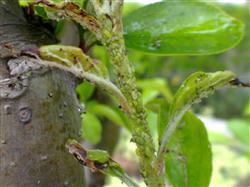 How to control aphids when growing fruit trees? Please introduce effective and practical control methods
The harm caused by aphids:When aphids pierce and suck plant sap, they secrete saliva, and because this saliva is toxic to plants, after it is injected into plant tissues it often causes leaf spots, curled and wrinkled young leaves, galls, tumors and various other types of damage. The excrement of aphids tastes sweet like honey and is called "honeydew"; it often covers flower leaves and branches, and as it accumulates, this dark substance blocks the leaf stomata, hindering the plant's physiological functions, inducing sooty mold in plants, and affecting plant respiration and photosynthesis.
For fruit trees, the following methods can be used to control aphids:
Physical control
1. Yellow board trapping of aphids: taking advantage of the yellow-attraction behavior of aphids, coat fiberboard, wooden boards or hard cardboard yellow, then apply No. 10 machine oil or petroleum jelly and other sticky substances on the outside to trap winged aphids, and replace the colored boards promptly afterward.
2. Silver-gray aphid repellent: silver-gray has a strong repellent effect on aphids, so silver-gray plastic strips can be hung in the orchard or silver-gray plastic film laid down to repel aphids. This method has a good effect on aphids spreading viruses during migration.
3. Aphid sex pheromone aphid repellent: drip aphid pheromone (400 milliliters) into a brown plastic bottle, hang the bottle in the orchard, and place a water basin below it so that the attracted aphids fall into the water and die.
Plant-based control
1. Tobacco leaves: soak 1 kilogram of dry tobacco leaves in 10 kilograms of hot water, rub them and remove them, add 10 kilograms of water and soak overnight, then rub again and filter. Mix the two filtrates, evenly combine with 10 kilograms of an aqueous solution containing 0.5 kilograms of lime, and spray.
2. Orange peel and chili: mix 1 kilogram of dried orange peel with 0.5 kilograms of dried chili, crush them together, boil in 10 kilograms of clean water, soak for 2 days, and the filtered extract can then be sprayed. This liquid has a contact-killing effect, and aphids die quickly after exposure.
3. Castor leaves: soak fresh castor leaves in 2 times their volume of water, boil for 15 minutes, and then spray.
4. Plant ash to repel aphids: for a single tree, it can be spread directly; when there are many trees, use 10 kilograms of dry plant ash per mu, put it into 50 kilograms of clean water and soak for 24 hours, then filter. Add 25 grams of 80% trichlorfon crystals (or omit it) to the filtrate, mix well and spray; this can control aphids, cabbage caterpillars and other pests. Spray once every 7~8 days, 3 times in succession, and the effect is good.
5. Plant ash specifically for pear psylla: the nymphs of pear psylla are surrounded by a layer of mucus, and when the damage is severe, conventional pesticide application is not very effective. Use a 3% plant ash extract filtrate and first spray it once on trees infested by pear psylla; after 3~4 hours, the mucus covering the pear psylla nymphs will disappear and the nymphs will be exposed, then spray pesticides for controlling pear psylla, such as 1.8% abamectin 3000-fold solution, and the control effect is greatly improved.
Trunk banding with pesticide
Mainly used on trees that are free of disease and growing vigorously; it takes effect in 3~5 days and the effect lasts 3 months. At the base of the main trunk 30 centimeters from the ground, choose a smooth spot, scrape off 7~8 centimeters of bark to expose the phloem, then wrap on a layer of cotton or old newspaper soaked with 40% dimethoate emulsifiable concentrate 5~10-fold solution, and then wrap a layer of plastic film on the outside. What are the reasons for dead branches and yellow leaves on fruit trees? After one week, remove the plastic film and take off the cotton and newspaper.
Protect and use natural enemies
The natural enemies of aphids include more than 80 species, such as ladybugs, green lacewings, hoverflies, minute pirate bugs, aphidiine wasps and aphelinid wasps, which can be introduced, bred or released. During the season when natural enemies reproduce in large numbers, reduce the number of pesticide applications as much as possible or choose low-toxicity pesticides. In our region, in mid-June during the late harvest period of wheat fields, large numbers of ladybugs move to fruit trees, so during this period pesticides can also be omitted on fruit trees, and the aphids will be eliminated.
Chemical control
Choose pesticides with high efficiency, low toxicity and low residue as much as possible, and rotate and alternate multiple pesticides to delay the development of aphid resistance. For example, 10% imidacloprid wettable powder 2000-fold solution; 1.8% abamectin 3000-fold solution; 2.5% cyhalothrin emulsifiable concentrate 1000~1500-fold solution, etc., have good effects.
Click to get more fruit growing techniques
Click to get more insecticide application techniques
Click to get more pesticide application techniques