How to control longhorn beetle larvae? Detailed explanation of control methods and technical key points
How to control longhorn beetle larvae? Longhorn beetle larvae cause very severe damage to fruit trees. How should they be controlled? Please provide methods. Damage caused by longhorn beetles: larvae of the bark-girdling longhorn beetle girdle the bark (gnawing the green surface layer of the trunk); larvae of the Miezi ridge tiger longhorn beetle damage branches and trunks, boring the xylem into crisscrossing tunnels and boring toward the center of the stem, damaging the pith, then boring downward to damage the roots. This seriously affects water transport, causing weakened tree growth, withered yellow branches and leaves, and symptoms of fertilizer and water deficiency.
 How to control longhorn beetle larvae? Longhorn beetle larvae cause very severe damage to fruit trees. How should they be controlled? Please provide methods.
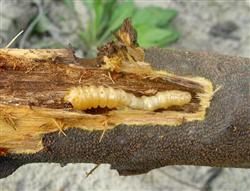
Damage caused by longhorn beetles:Larvae of the bark-girdling longhorn beetle girdle the bark (gnawing the green surface layer of the trunk); larvae of the Miezi ridge tiger longhorn beetle damage branches and trunks, boring the xylem into crisscrossing tunnels and boring toward the center of the stem, damaging the pith, then boring downward to damage the roots. This seriously affects water transport, causing weakened tree growth, withered yellow branches and leaves, and symptoms of fertilizer and water deficiency.
When damage occurs during the peak fruiting period, the fruit cannot grow, and damaged plants are easily broken by wind. In the later stage of damage, the affected tissue forms ring-shaped swellings due to stimulation, the cork layer of the bark splits, water cannot be transported upward, the upper branches and leaves become yellow and wilted, and lateral buds sprout densely on the lower part. When the larvae bore into the roots, the plant dies. In severe cases, the entire orchard can be destroyed.
Common control methods for longhorn beetle larvae can refer to the following measures:
Method 1: Strengthen management:Strengthen cultivation management, prune reasonably, pay attention to variety arrangement, and create a biodiverse planting environment, because a properly shaded environment has fewer tiger longhorn beetle infestations than a fully exposed environment, and vigorously growing fruit trees have a certain ability to resist insects.
Method 2: Promptly handle severely damaged plants:When finding branches parasitized by longhorn beetles, cut off about 20 cm of the damaged young stems, remove dead plants, and burn them in a centralized manner or inject pesticide into the insect holes. When stems and leaves suddenly wither in July to August, remove dead branches and carry out manual capture. Manually capture adults and larvae, and promptly cut down and burn damaged branches and trunks.
Method 3: Use chemical control:During the peak emergence period of adults, spray pyrethroid pesticides, including 2.5% deltamethrin (Decis), 2.5% cyhalothrin (Kung Fu), 5% esfenvalerate (Lefenling), 5% beta-cypermethrin (Gaoxiao Miebaike), 20% fenvalerate (Sumicidin), 20% fenpropathrin (Mie Saoli), (all above are emulsifiable concentrates) at 1000-4000 times, and 40% cypermethrin-monocrotophos mixture, 20% cypermethrin-fenvalerate emulsifiable concentrate, and 25% cypermethrin-dimethoate mixture at 2000 times. Organophosphorus pesticides, including 90% trichlorfon crystals, 80% dichlorvos, 40% omethoate, 50% fenitrothion, 50% methamidophos, 40% monocrotophos, 50% phoxim, 50% isocarbophos, 40% methidathion, 48% chlorpyrifos (Lorsban) (all above are emulsions) at 800-1000 times, and also 10% imidacloprid at 5000 times, spray garden trees or trap tree trunks once every 5-7 days, each time spraying thoroughly so that the pesticide solution flows along the trunk to the roots. Or spray the above pesticide solutions on woven bags or burlap pieces wrapped around tree trunks, or use these pesticide solutions to soak or spray trap branches and leaves. Or use the above pyrethroids at 200-400 times and organophosphorus pesticides at 50-100 times to paint trunks.
Method 4: Poison longhorn beetle larvae:For young larvae that have just entered the xylem, you can take dichlorvos, trichlorfon and other insecticidal agents at 20-30 times solution, use a large syringe to inject the pesticide solution into the insect tunnel. If the larvae have already penetrated deep into the branches and trunks and bored frass holes, find the lowest frass hole, inject the pesticide solution from there into the insect tunnel, then whittle a small wooden peg to tightly plug the hole opening, and the larvae can be killed inside. In production, medicinal mud, pesticide cotton balls, camphor balls, etc. are also inserted into insect holes to poison the larvae.
Method 5: Whitewash tree trunks:Use 10 parts quicklime, 1 part sulfur powder, 0.2 parts salt, 0.2 parts cattle glue (melted in hot water in advance), 30-40 parts water, or add 0.2 parts trichlorfon, and mix into a whitewash agent. To control citrus longhorn beetles, apply it to the trunk from the root crown to 30 cm above the ground. For other longhorn beetles, depending on the height of egg-laying sites, apply it within 2 m of the lower trunk above the ground, without missing any spots.
Click to get more insecticide application techniques
Click to get more pesticide application techniques