How to prevent and control sugarcane mosaic virus? Do not ignore the yellow-green stripes on the leaves
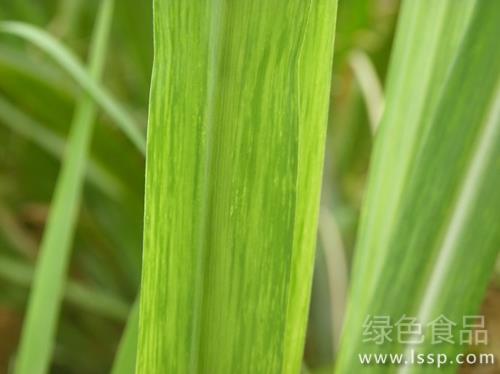
Sugarcane mosaic virus
(1) Symptoms and occurrence patterns of sugarcane mosaic virus
① Main symptoms: In the early stage of the disease, short stripes mixed with green and light yellow appear on banana leaves, including stripe-shaped, irregularly oval, and oblong forms, as well as small short needle-like ones or ones extending radially along the midrib. The symptoms of sugarcane mosaic virus are more obvious at the base of young tender leaves, and if held against sunlight, the lesions are clearly visible.
② Occurrence patterns: Sugarcane mosaic virus is a viral disease. The pathogen is rod-shaped, with a size of about 750 nanometers × 13 nanometers. The lethal temperature is 50-58℃, and it can survive outside the host for 1-2 days. The mosaic virus can infect 5 species of the genus Saccharum and some gramineous plants such as corn, sorghum, napier grass, crabgrass, and goosegrass. Among the 5 species of the genus Saccharum, Saccharum officinarum is highly susceptible, while Saccharum barberi, Saccharum robustum, Saccharum sinense, and Saccharum spontaneum are highly resistant or immune. When cultivars carrying strong resistance genes are used as seed cane, the plants are strongly immune or highly resistant. Relatively high temperature and low rainfall conditions favor the spread and expansion of the disease, but hot climates can inhibit disease development. Young sugarcane is more susceptible to the disease than mature sugarcane.
(2) Control methods
① Use sugarcane varieties with strong disease resistance, such as Guitang 11, Taitang 134, Mintang 70—611, etc.
② In severely affected areas, while eliminating highly susceptible sugarcane varieties, diseased plants should be pulled out, ratoon crops should not be retained in diseased fields, and intermediate hosts such as corn and sorghum should not be planted near sugarcane fields.
③ Sterilize sugarcane-cutting tools by roasting them over fire for a moment, eliminate insect vectors, and strengthen cultivation management.
④ For sugarcane seed cane suspected of carrying the disease, warm water soaking can be used. The method is: soak the seed cane at constant temperature 3 times, treating once every other day, for 20 minutes each time. The first soaking temperature is 52℃, and both the second and third are 57℃.