Control methods for pear tree canker after the cortex rots, gives off an alcohol smell, and then shrivels and dries
Pear tree canker, also known as stinking bark disease and dry rot, mainly attacks the main branches and lateral branches of pear trees, especially the sun-facing side of large branches and the junctions between branches. The affected parts develop long oval or irregular lesions, initially water-soaked and slightly raised, with the cortex rotting and turning brown, giving off an alcohol smell, and under pressure exuding reddish-brown sap. Later they gradually shrivel and sink, cracks form at the boundary between diseased and healthy tissue, and after rain yellow thread-like structures (spore horns) ooze out, while the diseased bark gradually lifts. In severe cases it causes branches or even the whole tree to die.
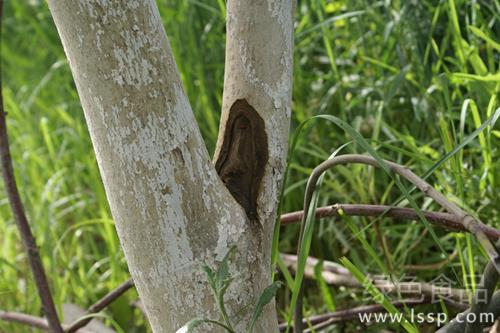
Pear tree canker
I. Causes of occurrence
The pathogen of pear tree canker overwinters as mycelium, pycnidia and perithecia in the diseased tissues of the tree. During the growing season, the pathogen spores spread and propagate by wind and rain, invading through various wounds, dead tissue, lenticels, leaf stalk scars and fruit stalk scars.
Causes of occurrence: (1) presence of the pathogen; (2) contiguous planting of susceptible pear varieties; (3) suitable climatic conditions; (4) poor management.
II. Control measures
1. Strengthen cultivation management, apply more organic fertilizer, strengthen tree vigor and improve disease resistance.
2. Prune reasonably and control the fruit load. According to conditions such as pear tree age, tree vigor and soil fertility, do well in flower and fruit thinning and in soil, fertilizer and water management, so that the pear trees carry a reasonable load and alternate bearing is eliminated.
3. Heavy bark scraping. During the dormant period, use a scraper to scrape off the epidermal layer of the diseased parts of the trunk until the white-green healthy bark is exposed. Be careful to scrape away all diseased tissue, and scrape carefully and meticulously at areas such as branch crotches to prevent scraping through the bark.
4. Scrape off the diseased tissue and coarse bark on the trunk and main branches, and spray a fungicide with penetrative properties and a long residual effect to eliminate latent canker pathogen on the bark, prevent infection by the pathogen and prevent disease onset. Spray the trunk and the base of large branches of pear trees with 40% asomate wettable powder at 50 times dilution or 5% chlorothalonil aqueous solution at 200 times dilution. After fruit harvest, spray once more in late autumn and winter.
5. At the early stage of disease onset, when the lesions are still small, carry out timely scraping treatment. Focus on summer and autumn and before onset in winter and spring. When scraping, be sure to scrape thoroughly. If there is no rot under the bark, scrape only the diseased epidermal tissue; if the disease is deeper, scrape clean both the xylem and the diseased bark, then apply medicine after scraping. Choice of chemicals: (1) Apply lime sulfur solution at 5-10 degrees Baume or 1% copper sulfate. (2) Apply the therapeutic repair agent "artificial bark" to the wounds on pear trees.
Control of pear tree canker
6. In late autumn, sweep up fallen pear leaves and remove diseased fruit and diseased dead branches to reduce overwintering sources of inoculum; from winter to before pear trees bud in early spring, remove diseased shoot tips and diseased dead branches together with pruning and burn them in a centralized manner; at the early stage of disease onset, promptly remove diseased flower clusters and diseased shoot tips. In February-March, collect the scraped diseased residues, take them outside the orchard, and bury them deeply or burn them in a centralized manner to eliminate the source of disease.
7. When the incidence of pear tree canker is high, use jiemanling : thiophanate-methyl : water = 16:1:800 for direct spraying.