How to Control Garlic Root Maggots Burrowing into Bulbs in Autumn
Root maggots, also called soil maggots or garlic maggots, reach their peak damage period in autumn. Therefore, in autumn, be careful to prevent garlic maggot larvae from burrowing into garlic bulbs, which causes the bulbs to rot and the above-ground garlic leaves to turn yellow, wilt, and even die.
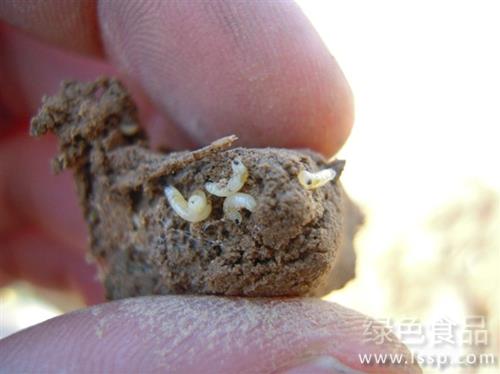
Garlic root maggot
Control measures:
Agricultural control. Use fresh seed garlic of uniform size that is disease-free and undamaged, rotate with non-onion and non-garlic crops for 3~4 years, and apply organic fertilizer only after it is fully decomposed; when used as a base fertilizer, bury it deep in the soil and keep it separated from the seed garlic. Garlic maggots like moisture and fear dryness. Spreading 150~200 kg of plant ash per mu around the roots of garlic gives fairly good control results. In plots where garlic maggots occur, if necessary, flood irrigation once can reduce the infestation.
Physical control. During the adult stage of root maggots, a trapping liquid can be made from brown sugar water, vinegar, and water in a 1:1:2.5 ratio, mixed with sawdust and trichlorfon, and placed in trapping basins for area-wide trapping; this can kill adults before egg laying, yielding twice the result with half the effort. Combined with watering, apply nitrogen-sulfur fertilizer that has a repellent and killing effect on garlic maggots to reduce the degree of damage. Irrigating twice with ammonia water before the garlic mother-bulb rotting stage helps repel adults. Irrigate less during the mother-bulb rotting stage to reduce the number of eggs.
Chemical control. At sowing, mix 3~4 kg of 5% phoxim granules per mu with 50 kg of cake fertilizer or fine soil and broadcast it in the sowing furrow. Treat seed garlic with chemicals using healthy, disease-free seed garlic, that is, mix each 50 kg of garlic seed with 5 kg of a 20-fold dilution of 80% trichlorfon, or mix 100~150 ml of 50% phoxim emulsifiable concentrate with 25~30 kg of water and treat 200~250 kg of seed garlic, sowing immediately after mixing. In the early stage of larval occurrence, broadcast 2.5% trichlorfon powder on the base of the garlic and the surrounding soil. Root drenching can also be done with 800~1000-fold 90% trichlorfon solution, 2000-fold 50% phoxim emulsifiable concentrate, 1000-fold 40% dimethoate emulsifiable concentrate, 400-fold pyrethrin, 300~400-fold ferrous sulfate, or 1000-fold 48% chlorpyrifos emulsifiable concentrate. Remove the swirl plate from the sprayer nozzle and inject the solution into the root soil, once every 10 days, applying 2~3 times depending on the pest situation.
During the peak adult occurrence period, spray promptly for control. For each mu of garlic, use 1.5~2 kg of 2.5% trichlorfon powder, or drench the roots with 1000-fold 40% dimethoate emulsifiable concentrate, 2000~3000-fold 2.5% deltamethrin emulsifiable concentrate, or 2000~2500-fold 25% phoxim-cypermethrin emulsifiable concentrate, once every 7 days for 2~3 consecutive times; applying between 9~11 a.m. gives the best results. Alternatively, mix 600~800-fold 80% dichlorvos with an appropriate amount of wheat bran and broadcast it evenly to fumigate and kill adults, then broadcast again after 7~8 days.