Overwintering cucumbers have poor disease resistance and many diseases: how to prevent and control common low-temperature diseases
In winter, overwintering cucumbers grown in greenhouses tend to grow weak, with the growing point shrinking or even stopping growth, poor disease resistance, and worsening diseases. In addition, after the onset of winter, North China is dominated by hazy days, and light and temperature inside the greenhouse are seriously insufficient, causing undesirable symptoms in greenhouse cucumbers.
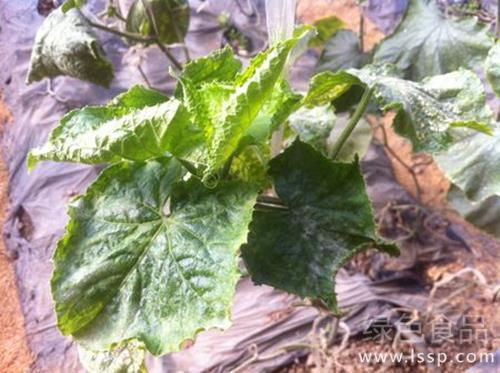
Cucumber flower topping
1. Flower topping:Flower topping, also known as cucumber topping, means the growing point of the vine retracts, the leaves are dark green, and the young cucumbers turn upward and rise above the growing point, with both reproductive and vegetative growth blocked at the same time. It is mostly caused by applying too much fertilizer at one time (especially phosphate fertilizer) or spraying excessive pesticide. Control measures: 1) Give the first heavy watering, applying a small amount of manure and urine with the water; 2) Spray gibberellin on the growing point; 3) Topdressing should be applied in small amounts many times.
2. Few cucumbers:Leaves and vines are dark green, thick, and large from top to bottom, with a diameter reaching 20 cm, and stems thicker than 1.2 cm, while the number of cucumbers is very small, with 1 cucumber every other node or 1 cucumber every few nodes, and yield is low. This symptom is caused by applying too much nitrogen fertilizer and insufficient phosphorus and potassium fertilizer. Control measures: 1) Do not apply or apply only a little nitrogen fertilizer such as ammonium nitrate, ammonium bicarbonate, and urea within 20 days; 2) Heavily apply compound fertilizer such as ammonium dihydrogen phosphate, applying 20 kg/mu for the first time, and then 10-15 kg/mu after 4-5 days; 3) Remove straw curtains late and cover them early, lower the temperature and shorten the light period during the day, and after 10 days the cucumbers will hang in abundance.
3. Flower abortion:It is caused by an imbalance between nutrient supply and demand. For flower abortion caused by malnutrition, apply heavy nitrogen fertilizer. For small leaves and thin vines, apply ammonium nitrate, which can promote broad leaves and strong vines; for large, thin, and yellow leaves, apply ammonium bicarbonate, which can make the leaf color dark green. Disease prevention should be early, spraying carbendazim and huimeijing in time, and uncovering and covering the straw curtain and greenhouse film early and late to prevent high night temperature, high respiration consumption, and insufficient nutrient accumulation. Keep the daytime room temperature at 24-28°C, not exceeding 30°C. At night, keep it at 14-18°C. If the root cucumber does not grow large, pick it appropriately early; pick it as soon as the flower of a mature cucumber begins to wilt. Through the above measures, flower abortion can be reduced and yield increased.
4. Brittle leaves:Cucumber leaves are dark green, dry, wrinkled, and uneven, with drooping leaf margins, and break when flicked with a finger. The cucumbers are small and few. This is caused by applying too little organic base fertilizer and using a monotonous topdressing. Control measures: Before transplanting cucumbers, apply chicken manure and cow manure. For topdressing, apply chemical fertilizer and human manure and urine alternately. Spray the leaves with 300-fold rice vinegar solution. If a small amount of yemianbao, lvdile, or photosynthetic trace fertilizer is added, the photosynthetic capacity of the leaves can be improved.
Cucumber excessive vine growth
5. Excessive vine growth:After greenhouse cucumbers are transplanted in early November, if there is continuous sunny weather with high temperature and high humidity, and if base fertilizer is insufficient during this period, the vine internodes will be too long (exceeding 8 cm), the stems will be too thick (diameter exceeding 0.8 cm), the petioles will be too long (exceeding 11 cm), the leaves will be too large (diameter exceeding 14 cm), and the angle between the petiole and the stem will be less than 45°; the leaves and stems are pale yellow, the leaves are too thick and too luxuriant, the growing point protrudes, the tendrils are slender, long, and white, and vegetative growth is excessive; diseases are likely to occur, reproductive growth is inhibited, young cucumbers decrease, and they do not expand. Control measures: 1) Lower the night temperature, gradually reducing the night temperature in the greenhouse from above 12°C to 5-6°C, hardening the seedlings at low temperature for 5-6 days, and then restoring it to about 12°C; 2) Stop watering, restrain the vines to promote cucumber growth, and water only after the young cucumbers on 60% of the vines have expanded, with less watering being better; 3) Increase ventilation during the day, increase light transmission, reduce the water content of leaves and vines, and appropriate water loss can make the fibers stronger; 4) Spray ethephon to increase cucumbers.
6. Frequent infectious diseases:From December to February of the following year, cucumbers are prone to infection by late blight and scab due to low temperature and insufficient light, and in the middle period, high temperature and high humidity make them prone to gray mold and bacterial angular leaf spot. Control measures: 1) Control humidity and preserve heat, keeping the greenhouse dry; 2) Chemical control, using 70% agricultural streptomycin or medical streptomycin, copper hydroxide, pyrimethanil, phosethyl-Al manganese zinc, fusixing, and secukeling smoke agents, etc., for comprehensive control of angular leaf spot, late blight, and scab, with good results.