Celery sclerotinia rot spreads fast, how to prevent and control the rot with white fuzz
Celery sclerotinia rot is an important disease in protected cultivation of celery, and it can occur from mid-to-late November each year until March of the following year. When it first appears, it affects individual plants; in severe cases, it spreads in patches or destroys the greenhouse.
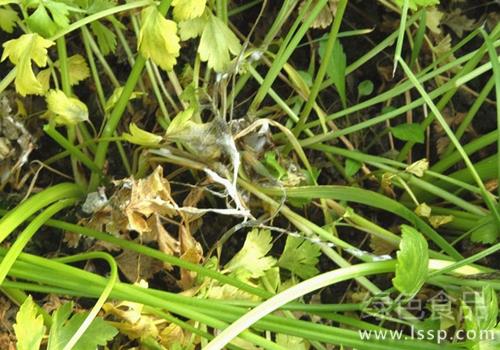
Celery sclerotinia rot
1. Symptom identification: When the disease first appears, water-soaked rot appears on the upper leaves, stem base, or leaves close to the ground of celery. When humidity is suitable, white cotton-like filaments grow on the diseased parts. Through contact between celery plants or overlapping branches and leaves, it spreads to healthy plants around them. Later, black, mouse-dropping-shaped hard sclerotia form among the hyphae.
2. Disease development pattern: The pathogen overwinters and oversummers as sclerotia in the soil, seeds, and diseased celery plant residues. When temperature and humidity are suitable, the sclerotia germinate to form apothecia, and ascospores are produced inside the apothecia. The ascospores spread with airflow. The spores germinate on the host, produce filaments that invade celery tissue, then develop into hyphae, and continue to infect the entire celery plant. Sclerotinia rot is likely to occur when the celery population grows densely and shaded, with low temperature and continuous cloudy, rainy, and humid conditions.
3. Prevention and control measures
(1) Use disease-resistant varieties, and seeds must be disinfected. Varieties such as Jinnan solid celery and western celery can be used; select disease-free plants for seed production, then soak celery seeds in 50°C warm water for 10~20 minutes, or in 1:200 formalin for 3 minutes.
(2) Strengthen cultivation management. Apply heavy basal fertilizer and combine it with phosphorus and potassium fertilizers to prevent celery from excessive vegetative growth and enhance disease resistance; use rational close planting to improve ventilation and light penetration in the later stage; in the later stage, control watering and greenhouse humidity properly according to the weather.
(3) Chemical control. In the early stage of the disease, pull out diseased celery plants, put them in plastic bags, carry them out of the field and destroy them, and use chemicals for prevention. You can use 40% dimethachlon wettable powder at 1000~1500 times dilution; or 50% iprodione wettable powder at 1000~1500 times dilution; or 50% carbendazim wettable powder at 500 times dilution for spraying. Apply once every 5~7 days, for 2~3 consecutive times. When spraying, start with healthy plants first and spray diseased plants last, so as to avoid spreading the pathogen through human operation. Smoke agents can also be used for control according to greenhouse humidity and weather conditions.