Lettuce bolting and splitting affecting yield? Common problems and solutions
Lettuce, namely stem lettuce, is widely cultivated and can be grown in all four seasons, but its optimum growing temperature is 10°C—25°C, with winter and spring cultivation being the best. In lettuce cultivation, the most common problems affecting yield and quality are lettuce “bolting” and splitting.
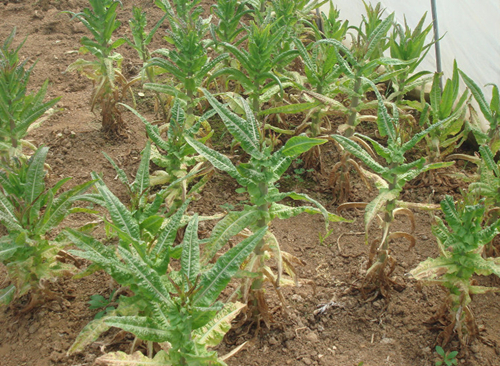
Lettuce bolting
“Bolting” refers to premature bolting of lettuce: in the middle growth stage, the edible stem becomes slender, the internodes of the leaves elongate, the leaves are thin and small, the outer skin is thick and the flesh is scant, the edible value is low, and the plant tends to bolt and flower. If the stem and leaf growth period of lettuce encounters high temperatures above 22-24°C and a day length of more than 12 hours, premature bolting readily occurs. When lettuce is cultivated in autumn, the seedling stage coincides with high temperatures, the day-night temperature difference is relatively small, respiration consumption at night is high, the stem readily becomes spindly, and the plant rapidly differentiates flower buds, thus causing autumn lettuce to “bolt”. In addition, transplanting over-mature seedlings, or insufficient water and fertilizer supply during the stem and leaf growth period, or excessive watering leading to poor vegetative growth, can also readily cause bolting and splitting.
Lettuce splitting
Splitting refers to the edible stem of lettuce splitting longitudinally in the late stage of expansion, with the split reaching as deep as the middle of the stem; the split part is yellowish-brown and prone to rotting. Causes: first, it is related to the variety; second, it is related to uneven water and fertilizer supply, with alternating drought and waterlogging, especially when the edible stem is maturing, the outer skin has already become lignified, and at this time heavy watering causes the edible stem to suddenly expand, but the skin cannot expand and therefore splits.
Solutions: choose medium- and late-maturing green-leaf lettuce varieties that are insensitive to day length and relatively resistant to splitting, and arrange their peak growth period in the suitable temperature season of about 20°C. When sowing, treat the seeds with low temperature to promote germination. Once more than half of the seeds have germinated, they can be sown. Raise seedlings under shade and keep the seedbed moist. When the seedlings have grown 2-3 true leaves, thin them out, with a seedling spacing of 5-6cm. When they have 5-6 true leaves, begin transplanting, and choose the afternoon for transplanting, with about 6000 plants per mu.
Second, strengthen fertilizer and water management after transplanting lettuce: within 2-3 leaf whorls after planting, control water to harden the seedlings, promoting the development of the lettuce root system and rosette leaves; when the heart leaves are level with the rosette leaves and the stem begins to thicken, water and apply quick-acting nitrogen and potassium fertilizer, promptly switching from “control” to “promotion”. Water and fertilizer must be timely; too early or too late is unfavorable. After watering begins, the stem thickens faster and the demand for water and fertilizer increases; water as soon as the soil surface dries slightly, watering evenly and in moderate amounts, and strictly avoid flood irrigation. When the field can be walked on, loosen the soil shallowly to break up crusting, and in conjunction with watering, apply topdressing 1-2 more times, each time applying about 15 kg of urea per mu, along with an appropriate amount of quick-acting potassium fertilizer; the fertilizer amount should not be too large, to prevent the stem from splitting.
Third, use plant growth regulators to inhibit bolting: in the late growth stage of lettuce, spray 800-1000 ppm of maleic hydrazide or 6000 times daminozide, which can increase yield and inhibit bolting, but note that plant growth regulators must not be sprayed during the lettuce seedling stage, otherwise bolting will be accelerated.
Fourth, harvest in good time: when the heart leaves of the lettuce are level with the outer leaves, it can be harvested; at this time the edible stem has fully expanded and the quality is crisp and tender. For harvesting in stages, the growing point at the top of the lettuce can be removed to prevent “bolting” or hollowing and aging. However, the interval should not be long, and if slight splitting is found in the lettuce, harvest earlier.