Garlic enters the critical period of yield formation, an analysis of key management points for the mid-to-late stage
1. Clearing ditches and regulating soil moisture: After garlic goes through a long growth period and field management, the drainage and irrigation function of most ditch systems in the field declines. With the arrival of the rainy season, especially in the mid-to-late stage of garlic growth, rainfall increases, and waterlogged conditions are prone to occur in plots with incomplete ditch systems, affecting garlic growth. Do a good job of clearing ditches and regulating soil moisture in garlic fields, ensure that the “three ditches” are complete, so that irrigation is possible in drought and drainage is possible in waterlogging, and the field dries after rain stops, preventing rain and waterlogging damage.
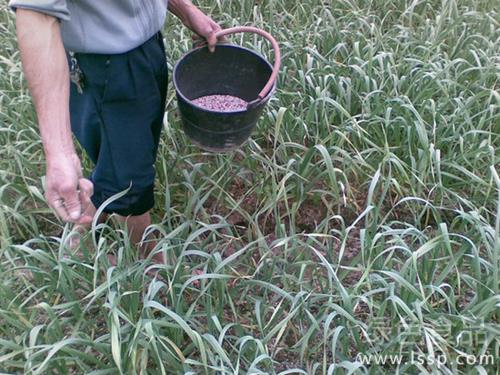
Garlic fertilization
2. Water management: As garlic enters the critical period for water demand, coupled with rising temperatures and more windy days, garlic's demand for water increases. Attention must be paid to garlic water management, and one irrigation for bulb expansion should be applied. For some elevated plots, use motor-pumped wells and other means to supplement water appropriately, so as to ensure the water needed for garlic bulb expansion.
3. Supplementary fertilizer: The period from garlic scape elongation to bulb expansion is the critical period for nutrient uptake. Due to different fertilization levels, there are obvious differences in garlic growth in the field. In some plots, garlic leaves turn yellow and growth is weak, so supplementary fertilization measures should be taken. First, apply fertilizer in combination with irrigation, applying 15-20 kg of urea per mu; second, spray organic foliar fertilizers such as 0.5% urea solution and 0.3% potassium dihydrogen phosphate solution; third, in the early stage of bulb expansion, use 200 ml of garlic bulb expansion agent per mu diluted with 40-50 kg of water for spraying.
4. Disease and pest control: In the mid-to-late stage of garlic growth, leaf diseases such as soft rot, leaf blight, and rust are prone to occur. Among them, soft rot is a bacterial disease, with yellow-white stripes running through the garlic leaves; when humidity is high, the diseased part becomes yellow-brown and soft-rotted. To control this disease, spray copper hydroxide, copper succinate-glutarate, etc. as early as possible at the initial stage of onset. Leaf blight mostly occurs at the leaf tips, initially appearing as small off-white round spots, which after expansion become irregular or elliptical gray-white to gray-brown lesions, with black mold-like growth attached. To control this disease, drain water promptly after rain, and at the initial stage of onset, promptly spray fungicides such as chlorothalonil and metalaxyl · mancozeb. Rust disease often shows brown raised spots on the diseased part, and after the epidermis ruptures, orange-yellow powdery material is released. To control this disease, avoid flood irrigation, and at the initial stage of onset, promptly spray drugs such as triadimefon.
5. Timely harvesting: First, harvest garlic scapes in a timely manner. For garlic grown mainly for bulbs, harvest when the garlic scape grows 15-18 cm, curves like a steelyard hook, the scape bud is obviously swollen, and the color changes from green to white. Second, harvest garlic bulbs at the right time. For dry garlic bulbs sold on the market, harvest when the basal leaves of the garlic are dry and withered, the pseudostem is soft, and when pressed forcefully to one side it has toughness; generally harvest about 20 days after scape harvesting. For fresh garlic sold on the market, generally harvest 5-7 days earlier than the harvest period for dry garlic bulbs, so as to maintain a crisp and tender quality.