Key Points for Winter Management of Oyster Mushrooms: How to Cope with Growth Inhibition Caused by Low Temperature and Dryness
After the Winter Solstice, temperatures drop further and the air becomes dry, affecting the metabolic function of oyster mushroom mycelium, the growth rate of fruiting bodies, and the number of primordium flushes. Especially in years with winter drought, low temperature combined with low humidity means that if management is improper, there is a high probability of dead mushrooms and deformed mushrooms appearing. Mushroom growers should manage all aspects well to promote high yields of oyster mushrooms.
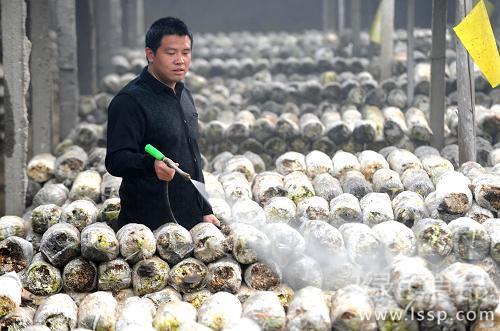
Watering Oyster Mushrooms
Scientific Water Use
When the temperature is below 5°C and the humidity is below 70%, it is difficult to meet the growth needs of oyster mushroom fruiting bodies, and artificial management must be strengthened. At this time, the moisture content of the substrate should be within 60%, and the amount of water sprayed on the bed surface should be reduced accordingly, with the focus on increasing humidity, bringing the mushroom yard humidity to 85%-90%. If humidity is low and mushroom bodies grow slowly, it not only prolongs the cycle but also results in low yield, dry mushroom bodies, and poor quality. Only when the temperature is relatively high each day should water be sprayed into the air, onto the ground, walls, and other areas to increase humidity.
Double-Layer Film Covering
During low-temperature cold waves and windy cooling weather, the effect of covering with double-layer film is quite obvious. A plastic greenhouse can be built, supplemented with an inner film covering. For those without such conditions, a thick straw curtain can be added on top of the first layer of film, and then a layer of film can be placed over the straw curtain. Practice has proven that mushroom beds covered with double-layer film have temperatures 3—5°C higher than those with single-layer film, with significantly faster mushroom body growth and significantly increased oyster mushroom yield.
Supplementary Nutrients
After several flushes of oyster mushroom harvesting, the nutrients and moisture in the substrate decline, and growing mushroom bodies often show symptoms such as thin caps, thin stems, solitary growth, small clusters, pale color, and cracked mushroom bodies. This is directly related to severe shortage of water and nutrients in the substrate and decreased ability of mycelium to decompose nutrients. When winter temperatures are low, combined with water supplementation, nutrients such as 3% soybean milk liquid, 10% rice-washing water, and 0.5% urea solution can be added to the substrate to regulate the carbon-nitrogen ratio, enhance mycelium active cells and decomposition function, and achieve the purpose of improving oyster mushroom yield and quality.
Reasonable Ventilation
To maintain normal metabolism of mycelium and fruiting bodies, ventilation and air exchange are necessary. Ventilate daily in conjunction with watering or harvesting to reduce the carbon dioxide concentration in the mushroom house to the lowest level, ensuring fresh air and sufficient oxygen in the mushroom house or inside the film. Ventilate for 1-2 hours each day when the temperature is relatively high.
Appropriate Lighting
Oyster mushroom mycelium does not need light for growth and is best kept in darkness. However, when forming fruiting bodies, sufficient scattered light is needed. Enhancing scattered light exposure can induce primordium differentiation of fruiting bodies, facilitate normal development of fruiting bodies, promote early maturity, and increase mushroom production. Therefore, during the fruiting period, scattered light conditions should be maintained in the mushroom house, not too dark, with light intensity at 200-1000 lux, but strong direct light is not needed.