Banana Fusarium wilt is highly destructive and the pathogen survives for a long time; what control methods are there?
Banana Fusarium wilt is highly destructive, caused mainly by infection with Fusarium oxysporum f. sp. cubense, with races 1 and 4 being the main ones distributed; race 1 harms Fenjiao (ABB group bananas), and race 4 harms both Fenjiao and banana (Cavendish). The pathogen can survive in the soil for several years, generally reducing yield by more than 20%, and in severely affected fields it can even cause total crop failure.
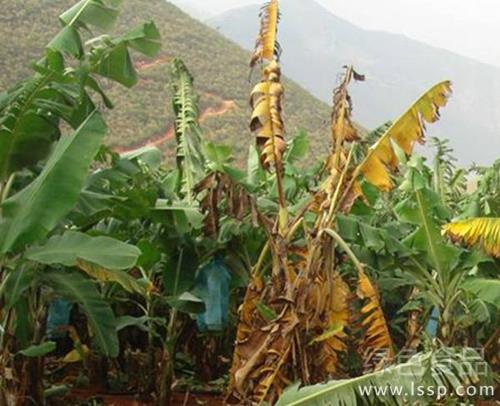
Banana Fusarium wilt
I. Damage symptoms
In the early stage of damage, the edges of the lower leaves and the outer parts of the leaf sheaths of the banana plant turn yellow, and this gradually spreads to the center, with the entire leaf rapidly turning yellow and wilting. The petiole near the leaf sheath bends downward, causing the leaf to droop; subsequently, in the diseased banana plant, all leaves except the top leaf turn brown and dry up from bottom to top; the pseudostem at the base splits longitudinally, and finally the whole plant dies.
II. Disease-inducing factors
Banana Fusarium wilt is a soil-borne vascular wilt disease. The primary infection sources are diseased banana seedlings and diseased soil. Factors such as high temperature and abundant rain, acidic soil, sandy loam, low fertility, heavy clay texture, poor drainage, poor permeability of the subsoil, and root injury from cultivation are favorable to the occurrence of the disease. Susceptible spring-planted bananas develop the disease in June-July, worsen in August-September, and reach a peak in October-November. Banana Fusarium wilt spreads over long distances through the transport and movement of infected banana seedlings, soil, farm machinery and tools, etc.; short-distance spread occurs through contaminated water and conidia.
III. Quarantine prevention and control measures
1. Seedling quarantine and management
Strict nursery management: strictly quarantine the suckers used for tissue-culture seedling production, and prohibit the selection of banana planting material from diseased areas and adjacent banana areas. Secondary banana seedling greenhouses should be built in high-lying places far from banana crops, using soil free of the banana Fusarium wilt pathogen for cultivation, irrigating with uncontaminated water, and disinfecting tools entering and leaving the greenhouse with agents such as formalin and carbendazim; set up disinfection rooms at entrances and exits, and strictly prohibit non-banana-seedling production personnel from entering.
Plant healthy banana seedlings: primary and secondary banana seedlings need origin and transport quarantine; it is strictly prohibited to move banana seedlings from diseased areas (except tissue-culture bottle seedlings and bag seedlings) and diseased soil to disease-free areas, and banana seedlings that have passed quarantine should be purchased.
2. Remove diseased plants
Promptly dig out diseased plants and dry and burn them on site. Where conditions permit, first inject glyphosate solution into diseased banana plants (inject at a height of 15 cm, 10 milliliters for large plants and 3 milliliters for small seedlings); after the plants die, collect the diseased plants and burn them in a centralized manner or bury them deeply. In areas with sporadic occurrence, other non-banana crops must be planted instead or the land used for other purposes; in severely affected areas, disinfect the soil around the diseased plants with agents such as lime or carbendazim, and carry out agricultural control.
Banana Fusarium wilt control
3. Agricultural control
Planting holes, tools entering and leaving diseased areas, soil, organic fertilizer, etc. should be disinfected with agents such as lime and carbendazim; plant disease-free propagation material (including suckers and tissue-culture seedlings) and relatively resistant (tolerant) banana varieties; adopt low-pressure micro-sprinkler irrigation technology, no-till or reduced tillage, and appropriately increase the application of phosphorus and potassium fertilizers or organic fertilizer; adopt paddy-upland rotation, or switch to other non-banana crops or other uses.
4. Chemical control
Use agents such as carbendazim to disinfect the soil of diseased banana fields 2-3 times to reduce the number of pathogens in the soil.