Zucchini Fruit Rot Caused by Four Diseases, with Detailed Control Methods
The following four diseases can all cause zucchini fruit rot, so early prevention is essential.
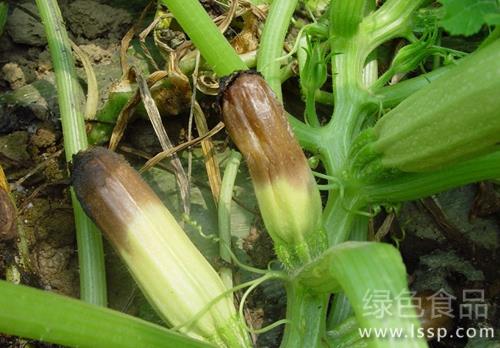
Zucchini Fruit Rot
The gray mold pathogen first invades withered and wilted spent flowers. In the early stage, the zucchini petals appear water-soaked, then become soft and rotten, growing a grayish-brown mold layer, causing the petals to rot, wilt, and drop off, and the pathogen then gradually spreads to the young fruit. The affected parts of the zucchini first become soft and rotten, then produce a large amount of gray mold.
Stem rot mainly infects the stems, vines, and fruit of zucchini. When the fruit is infected, it initially appears water-soaked, then softens, grows white mycelium, and develops scattered black sclerotia resembling mouse droppings. The control methods for zucchini stem rot and gray mold are basically the same, and can be controlled by combining flower dipping, spraying, and smoke fumigation. First, add 50% iprodione wettable powder at 500 times dilution to the flower-dipping solution. Second, spray 50% iprodione wettable powder or 50% vinclozolin water-dispersible granules at 1000 times dilution. Third, after closing the greenhouse, fumigate with 200 grams of 10% dimethachlon smoke agent per mu. To avoid phytotoxicity, fumigation should be carried out in the latter half of the night, and the greenhouse should be ventilated the next morning.
For zucchini fruit rot disease, in the early stage of onset, the fruit appears moist and rotten, and in the middle to late stage, the diseased part grows a dense mold layer that is white with a slight pink tinge, the diseased fruit rots, and juice flows out from the diseased part. To control fruit rot disease, spray 72.2% propamocarb hydrochloride aqueous solution at 600 times dilution or copper hydroxide 27.12% basic copper sulfate suspension concentrate at 500 times dilution.
For zucchini soft rot, in the early stage of onset, the diseased fruit appears brown and water-soaked, then rapidly softens, and the tissue of the diseased part rots. This disease spreads quickly, and after the diseased fruit rots, it gives off a foul odor but has no mold fuzz, which is the biggest difference from gray mold, stem rot, and fruit rot disease. Soft rot is a bacterial disease, and the pathogen is spread by rain, irrigation water, and insects, and invades through wounds. Pruning and training branches or carrying out farm operations on cloudy and rainy days or when dew has not yet dried can damage the base of leaf stalks and cause cracks, which can lead to pathogen infection and cause soft rot. To control soft rot, mainly use copper preparations, such as 50% copper bis(dihydrogen phosphate) (500 times dilution), or 20% copper resin acid ester emulsifiable concentrate (500-800 times dilution). Apply once every 7-10 days, for 2-3 consecutive applications, and stop applying 3-5 days before harvest.
For these four diseases of zucchini, in addition to chemical control, management should be strengthened to reduce humidity inside the greenhouse. When watering, water frequently but lightly, and choose to water at noon on sunny days. During consecutive cloudy days, use smoke agents for fumigation to control diseases, avoiding increased air humidity from spraying. On the basis of maintaining the temperature inside the greenhouse, pay attention to strengthening ventilation.