Cucumber leaf spots with target-like centers tend to turn yellow and wither: control methods for target spot disease in greenhouses
Cucumber target spot disease is a fungal disease caused by Corynespora cassiicola, also called Corynespora leaf spot. In recent years, with the continuous development of greenhouse cucumber cultivation, the disease has worsened year by year and has become an important leaf disease of greenhouse cucumbers, and may also cause damage to tomatoes and other vegetables.
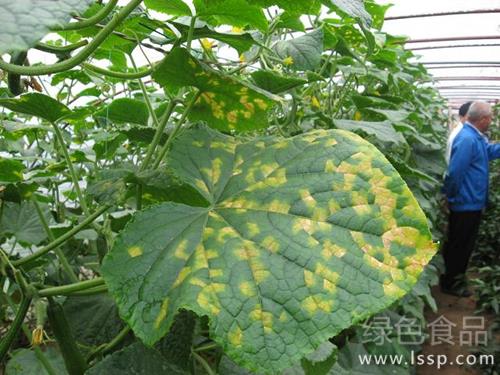
Cucumber target spot disease
Cucumber target spot disease occurs mostly after the full fruit-bearing stage of cucumbers. It first appears on the middle and lower leaves, forming yellow, round, sunken spots on the upper surface of the leaves, with a water-soaked appearance on the underside, commonly known as small yellow spot disease, and gradually expands into brown round or nearly round spots of varying sizes. In the later stage, the center of the spot becomes lighter in color, and there is an obvious target-like center in the middle of the spot, hence the name target spot disease. Affected by temperature, humidity, and cucumber disease resistance, the size, color, and mold layer of the spots may vary greatly, with most being 8-15 mm in diameter. When humidity is high, pale grayish-brown mold grows on both the upper and lower surfaces of the spots. When the disease is severe, the spots merge, the leaves turn yellow and wither, and elliptical grayish-brown spots also appear on stems and petioles.
Cucumber target spot disease is easily misdiagnosed as downy mildew or bacterial angular leaf spot. When identifying it, pay attention to the following features: the edges of spots of downy mildew and bacterial angular leaf spot are water-soaked, especially obvious in the morning. In contrast, the boundaries of target spot disease spots are clear; the expansion of downy mildew and bacterial angular leaf spot spots is limited by leaf veins and appears polygonal, while target spot disease spots are slightly round (especially in the early stage of the disease); when humidity is high, downy mildew spots grow a gray-black mold layer on the underside of the leaves, relatively sparse, while bacterial angular leaf spot exudes milky white turbid water-droplet-like bacterial ooze on the underside of the leaves, leaving white marks after drying, and target spot disease produces grayish-brown mold on both the upper and lower surfaces of the leaves. In addition, leaf spot diseases caused by Alternaria or Pseudocercospora fungi may also occur on cucumbers, but since the control techniques are similar, strict distinction is not necessary.
Cucumber target spot disease can be spread with seeds, including grafted pumpkin seeds, but more often it overwinters in the soil as conidia, chlamydospores, and mycelium with diseased cucumber residues, and produces conidia the following year, which spread by airflow and raindrops. This disease is an airborne disease favored by high temperature and high humidity. Large day-night temperature differences, long dew periods, weak plants, and plots with excessive nitrogen fertilizer application have more severe incidence.
To control target spot disease: soak cucumber seeds and black-seeded pumpkin seeds used for grafting in 55°C warm water for half an hour; practice crop rotation with celery, radish, tobacco, bitter melon, or non-cucurbit crops for more than two years, and pay attention to thoroughly removing diseased plant residues in the field and deep plowing the soil; avoid excessive nitrogen fertilizer application, increase phosphorus and potassium fertilizer application, and apply an appropriate amount of boron fertilizer. After watering, pay attention to ventilation and dehumidification. In the early stage of the disease, remove diseased leaves and carry out chemical control in time. The agents for controlling target spot disease are different from those for downy mildew and bacterial angular leaf spot. There are many options, including broad-spectrum fungicides mancozeb, carbendazim, thiophanate-methyl, and chlorothalonil; triazole agents propiconazole, difenoconazole, flusilazole, and tebuconazole; imidazole fungicides prochloraz and triflumizole; strobilurin agents kresoxim-methyl and pyraclostrobin; dicarboximide agent iprodione; as well as copper quinoline and Amistar. Because the pathogen easily develops resistance, reduce the number of applications as much as possible, rotate different types of agents, and use compound agents.