Control Methods for Greenhouse Strawberry Powdery Mildew Causing White Powder Coverage on Leaves and Poor Coloration
Powdery mildew is a major disease of greenhouse strawberries, mainly affecting leaves, flowers, fruit and fruit stems, and the leaf stalks are also affected. In the early stage of leaf damage, white powdery material grows on the underside of the leaves; as the disease worsens, the entire leaf is covered with white powder, the leaf margins curl upward into a spoon shape, and the leaves gradually wither and turn yellow. When flower buds are affected, the petals turn purplish red and do not open normally or fail to open. The strawberry fruit surface is covered with white powdery material, coloration is poor, and the young fruit stops expanding, loses its gloss and becomes hard.
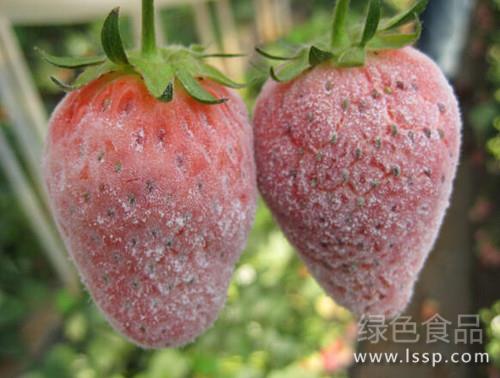
Strawberry powdery mildew
Factors behind the occurrence of strawberry powdery mildew: (1) Climatic factors. This disease is of the low-temperature, high-humidity type. The optimum temperature for onset is 15-25°C; below 5°C or above 30°C, the disease does not occur. The minimum humidity for disease occurrence is 40%, and the higher the humidity, the more severe the disease. From late autumn to early spring, when continuous cloudy and rainy days occur, with low temperatures, little sunlight and high humidity, the pathogen's conidia are continuously produced and repeatedly infect the plants, easily causing an epidemic. (2) Variety factors. The degree of disease occurrence varies greatly among different strawberry varieties. Mingbao and Yixiang are relatively resistant, while Fengxiang is susceptible. (3) Cultivation factors. Continuous cropping greenhouses show the disease earlier and more severely; excessive application of nitrogen fertilizer makes strawberry plants grow tender and green, with poorer disease resistance and more severe disease.
Agricultural control: (1) Select disease-resistant strawberry varieties according to local conditions. (2) In fields with severe powdery mildew, rotate with rice. (3) Clean the field. After strawberry harvest, promptly clear and burn diseased residues; before planting, remove weeds from the field; during the growing period, promptly remove diseased leaves, diseased fruit and old leaves, take them out of the greenhouse and burn them in a centralized manner. (4) Strengthen cultivation management. Cultivate strong seedlings and transplant at the proper time; ensure suitable plant and row spacing and reasonable close planting; ventilate in a timely manner, drain promptly after rain, and reduce field humidity; fertilize reasonably, using decomposed organic fertilizer and phosphorus and potassium fertilizers as base fertilizer, and during the growing period apply an appropriate amount of nitrogen-phosphorus-potassium compound fertilizer, without excessively applying nitrogen fertilizer; water scientifically, paying attention to water management after budding, during fruit expansion and at the peak harvest period, preferably using drip irrigation under film, not flood irrigation.
Chemical control: In the early stage of the disease, apply pesticide promptly, using Score 10% difenoconazole water-dispersible granules at 1000-1500 times dilution, or 12.5% myclobutanil emulsifiable concentrate at 1500-2000 times dilution, or 75% chlorothalonil wettable powder at 600 times dilution as a spray, once every 7-10 days, with 2-3 consecutive treatments. Spray evenly and thoroughly, covering both the front and back sides. In continuous cloudy and rainy weather, fumigation with chlorothalonil smoke agent is needed to reduce humidity inside the greenhouse. Do not apply pesticide during the flowering period to prevent phytotoxicity. Strictly observe the pesticide pre-harvest interval; generally stop applying pesticide 7 days before strawberry harvest to control pesticide residues.