Winter Covering for Chinese Chives Ensures Smooth Overwintering: Key Management Points for Winter Chinese Chives in Hoop Houses
I. Preparation before covering.After the Chinese chive leaves have been frozen dead by several hard frosts, use a shovel to level the dead leaves on the bed surface along the chive rows, then rake them clean with a bamboo rake. If the bed soil has already frozen, cover it with straw mats and similar materials at night; after the bed soil thaws, dig open the chive roots and sun-dry them for 5-6 days. Subjecting the bulbs to sun by day and freezing by night helps break dormancy, makes seedlings emerge uniformly, and kills some chive maggots. 2-3 days before covering, irrigate the chive clumps with 50% phoxim emulsifiable concentrate at 800 times dilution or 90% trichlorfon crystal at 500-600 times dilution, then broadcast decomposed organic fertilizer mixed evenly with soil, and immediately follow with a thorough watering, and you are ready to cover with film. Winter chives in sunlit beds are covered from Major Snow to Winter Solstice, and winter chives in small hoop houses are covered from Major Cold to Start of Spring.
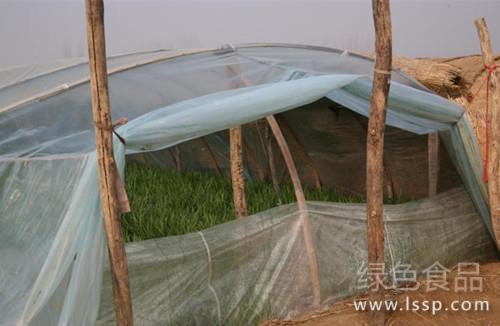
Ventilation for winter Chinese chives
II. Management after covering
1. Remove and replace straw mats in good time: During the day, the temperature in the covered chive bed should be 20-25°C, not exceeding 30°C, and at night not lower than 6-8°C. According to the bed temperature and weather conditions, remove and replace the straw mats in good time. Before the Chinese chives emerge, the straw mats should be removed late and replaced early: uncover them in the morning after the frost and snow on the mats have melted, and cover them again at 3-4 pm, so as to raise the bed temperature and promote early growth. After the Chinese chives emerge, uncover early and cover late to extend the light exposure time and help increase yield. On rainy and snowy days, as soon as the rain stops and the snow ends, sweep the accumulated snow off the straw mats and remove the mats; during consecutive cloudy days, also uncover the straw mats appropriately to let the Chinese chives receive light.
2. Be careful to clean the film: First, sweep away dust and bits of grass accumulated on the film to increase light transmission; second, knock off the water droplets condensed on the film inside the bed to help increase light and temperature. Generally, shake and tap 5-6 times a day and clean once a day. Whether sweeping or tapping, use gentle force to prevent damaging the film.
3. Ventilate in good time: When the Chinese chives grow to 29 cm tall and the bed temperature reaches 30°C, open vents appropriately at the back of the bed or at both ends of the small hoop house. This helps lower temperature and release moisture, replenish carbon dioxide in the bed, and prevent the occurrence and spread of gray mold and phytophthora blight.
4. Control Chinese chive gray mold and phytophthora blight: First, cultivate disease-free strong seedlings; second, manage temperature and humidity; third, when scattered Chinese chives in the bed are found to be diseased, spray pesticide at noon on a sunny, warm, windless day. For Chinese chive gray mold, use 50% carbendazim wettable powder at 600 times dilution, or 70% mancozeb wettable powder at 700 times dilution, or 50% procymidone wettable powder at 1500-2000 times dilution, focusing the spray on new leaves and the surrounding soil; for Chinese chive phytophthora blight, use 40% fosetyl-aluminum wettable powder at 500-600 times dilution, or 25% metalaxyl wettable powder at 600 times dilution, or 85% metalaxyl-mancozeb wettable powder at 500 times dilution for spraying or root drenching; the above pesticides are used at 40-50 kg per mu, sprayed once every 7-10 days, for 2-3 consecutive sprays.
5. Hilling soil: Use the hilling method to blanch the chive stems and improve the quality of covered chives. The specific method is: as the Chinese chives grow, apply sieved, air-dried, sun-warmed fine soil to the base of the chives in several applications.
III. Harvesting and management.For covered chives in sunlit beds, it takes about 30-35 days from covering to the first cutting; for small hoop houses, about 25-30 days. Choose noon on a sunny, warm day to cut the Chinese chives; uncover and cut as you go, uncovering only as much as you cut, to prevent cold damage. After the first cutting, apply an appropriate amount of fine fertilizer, rake the bed surface level, cover with film again, and water as dictated by soil moisture. After about another 25 days, cut the second time. After the second cutting, wait about another 30 days to cut the third time. After the third cutting, do not cut again. After the third cutting, the weather has already turned warm, so the covering can be removed and fertilizer and water management strengthened to allow the Chinese chives to resume growth.