Key points for winter clearing of asparagus fields to ensure overwintering and harvest the following year
Winter field management of asparagus includes clearing the field, topdressing, watering, loosening the soil, disinfection, and weeding. Its purpose is to ensure that asparagus overwinters safely and to make full preparations for harvest the following year.
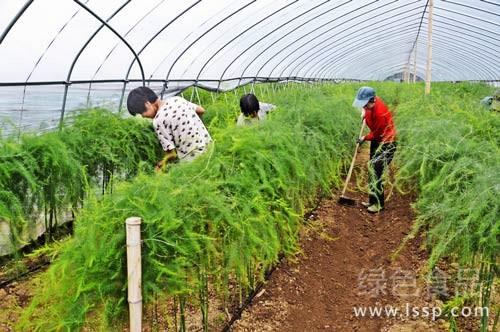
Asparagus management
Clearing the field means thoroughly cleaning the asparagus field, mainly removing withered asparagus stems and branches as well as stubble and fallen leaves. Clearing the field not only benefits harvest, but is also an important measure for controlling pests, diseases, and weeds. The field must be cleared cleanly and thoroughly, especially in plots with severe pest and disease problems; thorough clearing helps reduce pathogens and control disease outbreaks. The specific methods are as follows:
1. Pull out dead branches and sweep the asparagus field. When the aboveground stems and branches of asparagus have completely withered, pull out the stems and branches individually by hand. When the aboveground parts have not completely withered, they must not be pulled out, otherwise nutrients will be wasted, affecting the yield and quality of asparagus the following year; moreover, stems and branches that have not withered are also difficult to pull out, and forcing them out easily damages the bud scales. In addition, when clearing the field, do not cut with a knife; pull out the dead stems individually, and remove the stubble cleanly, sweeping it out of the asparagus field together with the dead branches and fallen leaves and burning it in a centralized place.
2. Disinfect the soil and control pests and diseases. After strict field clearing, a considerable number of pathogens still remain in the soil. To further reduce pathogens and control disease outbreaks, soil disinfection should be carried out after clearing the field. The methods are: (1) spray a 600-800 times dilution of chlorothalonil or a 300-500 times dilution of 50% carbendazim; (2) drench the roots with a 500-600 times dilution of carbendazim or a 120-200 times dilution of agricultural antibiotic 120; (3) broadcast fine sandy soil mixed with carbofuran on the soil surface, applying 1.5 kg of carbofuran mixed with 15 kg of soil per mu.
3. Topdressing, watering, loosening the soil, and weeding. Open furrows on both sides of the asparagus for topdressing. When topdressing, keep away from the root system. Generally, apply 50 kg of compound fertilizer and 1000 kg of high-quality decomposed farmyard manure per mu. After topdressing, water promptly, and hoe and loosen the soil at the appropriate time to preserve moisture, increase humidity, and raise temperature. After fertilizing, spray the herbicide chlorpropham at 140-200 ml per mu to prevent biennial weeds (before young stems sprout in early spring, after intertillage and earthing up, a mixed herbicide may be sprayed, using 140 ml of fluorochloridone plus 70 ml of linuron per mu to control annual weeds; during the harvest period, herbicides are prohibited).
Note: (1) Dead branches should be pulled out when the weather is expected to be clear and fine in the coming days. Do not water immediately after pulling, otherwise the asparagus wounds are prone to infection and the underground parts may rot. (2) Residual stems and dead branches and fallen leaves must be thoroughly removed and burned in a centralized place far from the asparagus field. (3) When topdressing, the fertilizer must be kept away from the asparagus so as not to damage the root system, and fully decomposed farmyard manure must be used.