How to manage loquat during the winter-spring flowering and fruiting period to achieve large fruit and excellent quality
Loquat is one of the few fruits that flower and set fruit in winter and spring and ripens in late spring and early summer, a time when fruit is in shortest supply, so large, high-quality loquats have always commanded high prices. At present, however, loquat production commonly suffers from small fruit, low yields and poor returns. The growth and development of loquat flowers and fruit occur in winter and spring, so to make loquat fruit large and of excellent quality, management during winter and spring must be strengthened according to this growth characteristic of loquat.
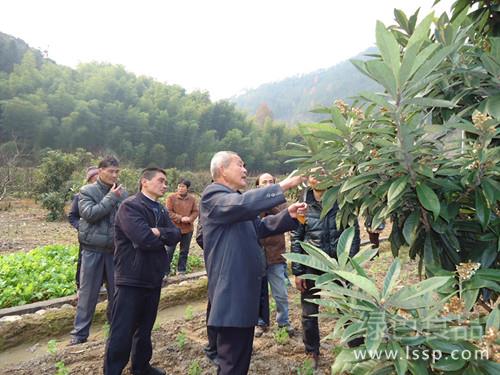
Loquat flower thinning and shaping
1. Orchard cleaning and pruning.Before the Start of Winter, prune out diseased and pest-infested branches, tangled branches, weak branches and overlapping, overly dense branches within the canopy, and clear all weeds, dead branches and fallen leaves from the orchard, burying them deep or burning them in a centralized manner. Spray once with a mixture of 50% carbendazim or 70% thiophanate-methyl plus 1000-fold dichlorvos, and whitewash the loquat trunk and large side branches with a whitewash agent.
2. Heavily apply pre-bloom fertilizer.Loquat has a high demand for potassium fertilizer; following the principle of balanced fertilization, the nitrogen, phosphorus and potassium ratio in a general orchard is 2:1:3. Loquat orchards on mountainous red soil should appropriately increase the application of phosphorus and potassium fertilizers. At present, pre-bloom fertilizer should be applied heavily; in mid-to-late November, dig trenches on both sides along the drip line of the canopy, each 1 m long, 0.5 m wide and 0.6 m deep. Organic fertilizer should be the main component; for large mature trees, apply 20 kg of dry rice straw or dry weeds, 1 kg each of lime and compound fertilizer, and 40-50 kg of decomposed manure, pressing the green material in layers; where conditions permit, in a dry winter, irrigate 1-2 times per month to resist drought and retain moisture, so that the fertilizer fully decomposes and dissolves for the tree to use.
3. Flower and fruit thinning.The number of flowers needed for loquat to form a crop is only 5-10% of the total number of flowers; thinning flowers and fruit can reduce nutrient consumption, increase single-fruit weight, make loquat fruit uniform in size, improve quality, and also overcome alternate bearing. The loquat flowering period is long, with the whole tree flowering for more than 3 months; flower thinning is carried out from November to February of the following year, and the earlier the better. It is best done when the flower clusters are already obvious but have not yet opened; thinning flower clusters too early not only easily removes fruiting branches but also often promotes a second flush of flower clusters; too late and nutrients have already been consumed, losing the effect of regulating nutrients. Thin out overly dense and slender weak flower clusters; on a mother branch with multiple flower clusters, keep only 1-2, retaining about only 2/3 of the tree's total flowers. Thinning principles: “remove late ones and keep early ones, remove small ones and keep large ones, remove outer ones and keep inner ones”, and thin more heavily at the top of the canopy. In the absence of disease, if it can be determined whether young fruit should be kept, fruit should be thinned as early as possible; diseased and pest-damaged fruit, deformed fruit and overly dense fruit should all be removed, and it is appropriate to keep 3-5 fruit per cluster. Where conditions permit, bagging can be carried out right after fruit thinning is finished, so as to produce high-quality fruit and improve marketability.
4. Apply fruit-swelling fertilizer well.The fruit-swelling fertilizer is best applied in two split applications. The first is applied in early-to-mid February after flower thinning and before the spring shoots sprout, to promote young fruit growth and reduce fruit drop. The second is applied in early-to-mid April during the rapid expansion period of loquat young fruit. Per plant, apply 20-30 kg of farmyard manure, 40-50 kg of human excrement and urine, and 4-5 kg of superphosphate, and spray the foliage with a mixture of 0.2% monopotassium phosphate plus 0.1% borax, spraying once every 7-10 days for 2-3 consecutive sprays, which can prevent fruit drop.
5. Prevent and control diseases and pests.The main loquat diseases are anthracnose and leaf spot. Control methods: in winter, remove diseased branches and leaves, and in the early stage of branch shoot or flower cluster emergence, spray 1-2 times with 50% carbendazim wettable powder at 800-900-fold dilution or with an enemy-granule stripping agent mixed with water.