Northern blueberries have poor lignification, shallow root systems, and are not cold-tolerant. How can they be protected from the cold and overwintered?
Blueberry branches have a poor degree of lignification and the root system is relatively shallow, so blueberries have poor cold tolerance. Blueberries cultivated in the open field in cold northern regions must be protected from the cold. The following introduces several practical cold-protection methods for blueberries.
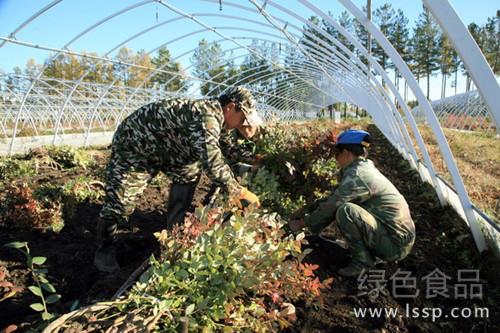
Blueberry mulching for cold protection
1. Mulching cold-protection method.Before the ground freezes, cover the blueberry plants with leaves, rice straw, straw curtains, woven bags, etc., which can provide protection. Before cold protection, irrigate thoroughly. It works well in areas where the winter minimum temperature is above -15°C; a covering thickness of 5-8 cm is sufficient. In areas where the winter minimum temperature is below -15°C, the covering thickness can be increased. With this method, blueberries in relatively dry winter areas may still suffer from branch dieback, and the results are not entirely satisfactory.
2. Snow-piling cold-protection method.In snowy areas, snow can be piled artificially. Because materials are easy to obtain, it has the advantages of saving labor, saving time, costing little, and maintaining soil moisture. Generally, the covering thickness should be 2/3 of the plant height, and the suitable thickness is 15-30 cm. Snow-piling cold protection works well, with few branch dieback phenomena, and yield also increases. However, this method is limited by region and cannot be used in areas with little snowfall or no snow accumulation.
3. Soil-mounding cold-protection method.In Northeast China, the soil-mounding cold-protection method can be used in blueberry cultivation. Before winter, press the branches down and cover them with soil. Soil-mounding cold protection works well, with very slight branch dieback and good growth and fruiting. However, blueberry branches are relatively brittle and easily broken. Therefore, orchards using soil-burial cold protection should plant at an angle or use this method during the young tree stage. When the plants grow larger, the amount of soil mounding increases, and together with removing the soil in spring, it not only costs labor and time and increases input, but also causes great damage to the plants, often breaking branches and damaging flower buds, affecting growth and fruiting.
4. Double-layer covering cold-protection method.A cold-protection method using straw curtains and plastic film is suitable for blueberry orchards of 3 years or older. Before cold protection, along the row and based on the blueberry planting line, set up a horizontal beam slightly higher than the blueberries, using wooden poles, bamboo poles, or iron pipes. On the erected horizontal beam, cover plastic film. The width of the plastic film should be such that both sides hang down to the ground and can be held down with soil. After pressing soil firmly at the ground contact points on both sides, cover with straw curtains. The straw curtains must be fully covered and must not expose the plastic film, then fix them with guy wires or clips to prevent strong winds from blowing them open. Double-layer covering uses more cold-protection materials, but it saves relatively more labor during cold protection, and the materials can be reused for 3-4 years. Importantly, the cold-protection effect is good. In areas where the winter minimum temperature is not lower than -25°C, there is almost no freezing damage or branch dieback, the plants grow robustly, and blueberries have good quality and high yield.Several points should be noted when using the double-layer covering cold-protection method: the timing of cold protection must be appropriate and not too early; it is best when the outside maximum temperature is stable below 5°C. Too early will cause the buds to be damaged by heat (commonly known as "smothering the buds"). Before cold protection, if soil moisture is poor, irrigate thoroughly once. In the following spring, remove the cold-protection materials promptly and all at once.