How to prevent and control tipburn in Chinese cabbage causing yellowing leaf edges and rotting leaf flesh of the heart leaves
Tipburn of Chinese cabbage, also known as dry heart disease, is a physiological disorder that occurs in the middle and late stages of Chinese cabbage growth. It is widespread in all regions and is one of the important diseases of Chinese cabbage.
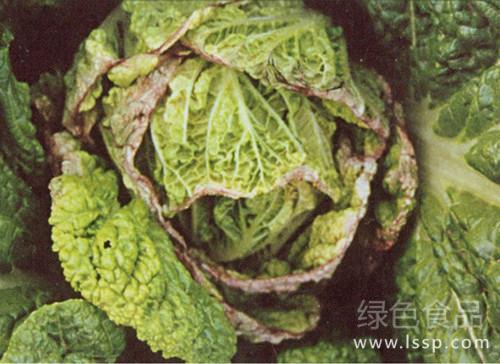
Tipburn of Chinese cabbage
Symptoms and causes:
The typical symptoms are: the outer leaves grow normally, but after cutting open the head, some heart leaf edges can be seen turning white, yellow and dry, with the leaf flesh appearing dry and sunken. Chinese cabbage affected by tipburn is susceptible to soft rot, with severe rotting and a foul odor. The cause of tipburn in Chinese cabbage is physiological calcium deficiency or manganese deficiency, and physiological calcium deficiency is caused by dry weather, insufficient or uneven watering, saline-alkali damage, and excessive nitrogen fertilizer. The control methods are:
1. Select disease-resistant (tolerant) varieties.Adapt to local conditions and select Chinese cabbage varieties with disease resistance or tolerance. Such as Beijing Qingqing, Tanggu Dahetaowen, Tianjin Xinhe Zhonghetaowen, Zhongbai No. 4, Dalian Qingza Zhongfeng, etc.
2. Select suitable garden fields.Fields with fertile soil and low salt content should be selected. The specific requirements are: the soil organic matter content of the vegetable field should be above 3%, the total salt content below 0.2%, and the sodium chloride content below 0.05%.
3. Scientific water management.Before sowing, water thoroughly. During the seedling stage, small amounts of water applied frequently are recommended. During the rosette stage, moderate seedling hardening may be carried out according to weather, soil moisture and growth conditions; in dry weather, seedling hardening may also be omitted. After seedling hardening, water thoroughly once. During the heading stage, keep the surface moist. After irrigation, cultivate in time to prevent soil compaction and the rise of salt and alkali. Avoid irrigating fields with sewage or brackish water.
4. Rational fertilization.For soil that has long used ammoniacal nitrogen, increase the application of farmyard manure, plow deeply and apply sufficient base fertilizer, improve water and fertilizer retention, improve soil structure, and control the amount of nitrogen fertilizer according to soil fertility, generally 240-60 kg per mu is appropriate; at the same time, increase the application of phosphorus and potassium fertilizers.
5. Supplement calcium.For acidic soil, appropriately increase the application of lime to adjust the pH and facilitate the absorption of calcium by the Chinese cabbage root system. At the late rosette stage of Chinese cabbage, 3-4 grams of granular fertilizer or secondary calcium granular fertilizer can be applied to the heart leaves of each plant. Alternatively, starting from the middle rosette stage, spray the heart leaves with a mixed solution of 0.7% calcium chloride plus 50 mg/kg naphthaleneacetic acid, once every 7-10 days, for 4-5 consecutive sprays, which has the effect of preventing and controlling tipburn of Chinese cabbage.