Cauliflower leaf veins turning black, dry and brittle, or rotting? Black rot control methods
Besides harming cauliflower, black rot also attacks cabbage, kale, radish and other cruciferous vegetables. It is a bacterial disease caused by Xanthomonas campestris. In recent years, cauliflower black rot has been worsening year by year, seriously affecting the yield and quality of cauliflower.
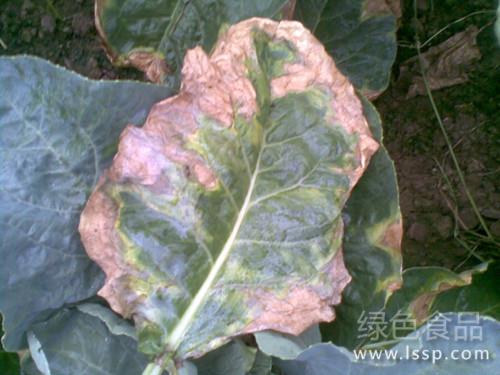
Cauliflower black rot
I. Symptoms:
After cauliflower is infected by the pathogen, the disease starts from the leaf margins, spreading inward and to both sides from the tip of the leaf vein to form a “V”-shaped yellow-brown lesion; the leaf veins become necrotic and black. When the air is dry, the diseased part is dry and brittle; when humid, the tissue of the diseased part rots, and the vascular bundles of the stem and roots also turn black.
II. Control measures:
1. Seedbed disinfection:For each square meter of seedbed, use 30-40 ml of formalin diluted in 2.5-5 kg of water, then spray with a sprayer (with the nozzle removed), turning the soil while spraying. After even spraying, cover with agricultural film. Remove the film after one week and turn the soil several times to fully volatilize the formalin; this takes about 5-7 days.
2. Seed treatment:Cauliflower seeds can be soaked in a 200-fold solution of 50% amobam aqueous solution for 15 minutes, then washed clean, air-dried and sown. Soaking seeds in warm water will affect the germination rate of cauliflower, so it should be used with caution and avoided as far as possible.
3. Seedbed management:If raising seedlings in summer, use protected cultivation, add a shade net to prevent sun scorching and rain washing. After the seedlings emerge, check the seedling condition frequently to ensure uniform and strong seedlings. If there are diseased seedlings, pull them out promptly and spray for control. Throughout the seedling-raising period, control diseases and pests such as damping-off, seedling blight and imported cabbageworm.
4. Crop rotation:Rotating cauliflower with non-cruciferous vegetables for more than 2 years can solve the problem of soil-borne pathogens. To eliminate or reduce pathogens in the soil, deep-plow and sun the soil for 10-20 days before transplanting, to speed up the decomposition of plant residues and the death of pathogens in the soil.
Cauliflower management
5. Fertilizer and water management, hoeing and weeding:When transplanting seedlings and after they recover, apply sufficient seedling fertilizer. During the growth period of cauliflower, apply fertilizer and water 2-3 times to prevent premature aging and enhance disease resistance. Avoid flood irrigation to reduce chances of pathogen spread. According to soil moisture, hoe and weed in time.
6. Pest prevention and control:Besides causing direct losses, pests also provide a route for pathogens to infect through wounds. Therefore, in plots with many pests, black rot is also severe. To prevent disease, pests must first be controlled, especially imported cabbageworm and diamondback moth.
7. Disease prevention and treatment:After black rot appears on cauliflower in the field, control it promptly. A 500-fold solution of 50% amobam, or agricultural streptomycin, streptomycin sulfate, and ningnanmycin at 200 mg/kg, have obvious control effects. In addition, 50% thiophanate-methyl and 50% carbendazim wettable powder also give very good control effects.