How do strawberries cope with disastrous weather? Three key points for safe overwintering
Greenhouse strawberries often encounter disastrous weather such as strong winds, blizzards and dense fog in winter and spring. Although such disastrous weather occurs infrequently, once it happens, without corresponding measures, the losses are severe. The management experience on how to cope with disastrous weather is now introduced to everyone.
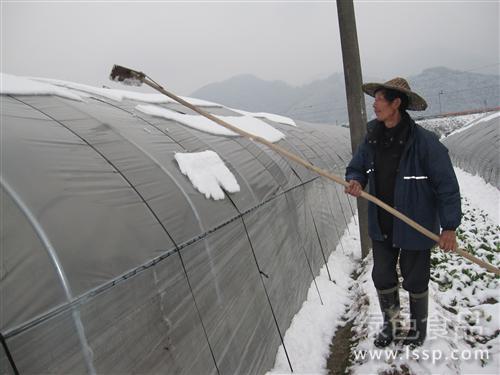
Clear snow from the strawberry greenhouse
1. Management on windy days:If strong winds occur, the greenhouse film will bulge in the wind and flap up and down. If not managed in time, the greenhouse film will be blown open, and the strawberries inside will suffer freezing damage.
Management measures: Seal all ventilation openings tightly to prevent strong winds from blowing into the greenhouse and harming the strawberries and damaging the greenhouse film. Tighten the film-pressing lines; when necessary, lower part of the straw mats to press the greenhouse film firmly. If strong winds occur at night, press the straw mats firmly; it is best to place woven bags half-filled with soil on part of the straw mats to prevent the strong winds from blowing the straw mats off.
2. Management on snowy days:When snow falls in early winter and early spring, the outside temperature is not very low, and the snow may melt as it falls, soaking the straw mats. This not only affects heat preservation, but also makes it difficult to roll and unroll the straw mats, and can easily crush the greenhouse frame. Therefore, uncover the straw mats before snowfall, and after the snow stops, clear the accumulated snow, then put the straw mats back down. In blizzard weather in deep winter, the outside temperature is low, and the straw mats must not be uncovered, otherwise the strawberries in the greenhouse will be frozen.
Management measures: Heavy snow pressing on the straw mats can easily crush the greenhouse frame, so the accumulated snow on the straw mats must be cleared in time. Snow beside the greenhouse walls must also be cleared to prevent melted snow from seeping into the greenhouse through the soil, which would not only carry away heat but also damage the greenhouse walls. During the day, sweep the snow off the greenhouse film to enhance the light transmission of the greenhouse. Raise the greenhouse temperature, adopt temporary measures, and reasonably regulate the greenhouse temperature to prevent gas damage. To increase temperature and prevent freezing, small arch sheds can also be set up inside the greenhouse. Improve lighting: uncover the straw mats early during the day, but do not uncover them all at once, to prevent excessively strong light after the snow clears and turns sunny, which would cause the strawberries to lose water and suffer permanent wilting.
3. Management on cloudy and foggy days:Cloudy and foggy days often occur in winter. In such weather, the light in the greenhouse is less than 1/5 of that on sunny days, the relative air humidity is above 95%, and the indoor temperature is below 15°C. This not only limits the photosynthesis of strawberries and reduces photosynthetic products, delaying the strawberry ripening period; if cloudy and foggy days last for several consecutive days during the strawberry flowering period, it will greatly reduce the fruit-setting rate of strawberries, produce deformed fruits, and lead to reduced yield and deteriorated quality.
Management measures: First, increase artificial supplementary lighting. Incandescent lamps can be used as the light source for heating treatment; each 100-watt lamp lights about 7.5 sq m, heating for 5 to 6 hours every day from 5 p.m. to 10 p.m. can increase strawberry yield by 30% to 50% and reduce deformed fruits by 50%. Second, reasonably control temperature. Install temporary heating equipment, carry out heating at night, and ventilate briefly around noon to control the daytime temperature in the greenhouse at about 20°C and the nighttime temperature above 10°C. Third, assist pollination. During the strawberry flowering period, raise bees to assist pollination; through bee pollination, the fruit-setting rate can be increased by 50% to 70%, improving strawberry yield and quality.