Six key points for winter apple management: topdressing, pruning, freeze protection, and pest and disease control
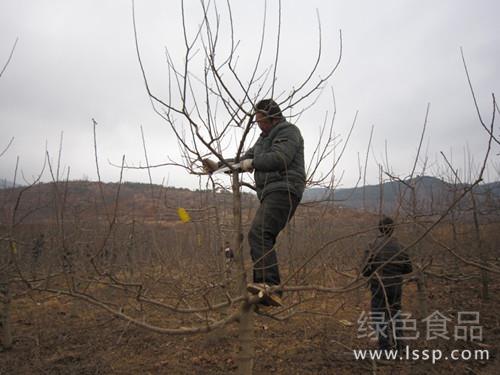
Apple overwintering management
Apply basal fertilizer.Basal fertilizer means combining organic fertilizer with inorganic fertilizer, combining nitrogen, phosphorus, and potassium, and combining macroelements with microelements. The amount of fertilizer applied should be determined according to the size of the apple tree, the yield, the tree vigor, and the soil fertility. Generally, for every 50 kg of apples produced, 2 kg of pure nitrogen, 0.5 kg of phosphorus, and 1 kg of potassium are needed, equivalent to 100 kg of barnyard manure and 0.25 kg of urea.
Pest and disease control.Physical trapping and killing of insects is advocated. Tie grass bundles or pieces of worn burlap on the large branches of apple trees to lure pests to pupate and overwinter, then kill them in a concentrated way. Next is removing mummified fruit, pruning out diseased and pest-infested branches, and cleaning up dead branches, fallen leaves, weeds, and so on in the orchard, then burning or deeply burying them in a concentrated way to reduce sources of pests and diseases. Then there is chemical control: after apple harvest, spray the whole orchard once with a fungicide and an insecticide. Promptly scrape off old bark and burn it in a concentrated way; after scraping, disinfect with 5-degree lime sulfur mixture or 1% copper sulfate solution. For severe cases, after leaf fall, spray the whole tree with 800-1200 times dilution of ring rot net or 10% agricultural antibiotic 120, which can eliminate overwintering insects.
Deep plowing to improve the soil.Deep plowing can improve the physical conditions of the soil such as water, fertilizer, air, and heat, keep the soil fertile and loose, and create favorable conditions for root growth. At the same time, it exposes overwintering cocoons and pathogens in the soil so they die. Deep plowing can be carried out together with fertilization, and a plowing depth of 30-60 cm is suitable. For heavy clay soil, an appropriate amount of sand can be added; for sandy orchard soil, a small amount of clay can be mixed in.
Safe freeze protection.First, whitewash the trunks to buffer the drastic changes in apple trees caused by direct sunlight and to prevent sunscald and freezing. Make the whitewash with 10 parts quicklime, 1 part sulfur, 10 parts water, plus an appropriate amount of adhesive; when applying, the sun-facing side should be coated more thickly. Second, for apple trees in cold areas and on shady sides, in addition to foliar spraying of potassium dihydrogen phosphate and whitewashing, methods such as wrapping with grass, wrapping with plastic film, laying grass on the ground, laying plastic film, mounding soil, applying antifreeze agents, and fruit tree pruning sealant can also be used to prevent freeze damage.
Prevent ring rot.Control methods: 1. Strengthen cultivation management, apply more organic fertilizer, store nutrients, avoid excessive application of nitrogen fertilizer and late-stage irrigation. During orchard operations, tools such as pruning shears, saws, and ring-barking knives must be disinfected once after each use to prevent transmission. 2. Promptly remove and destroy diseased branches, diseased bark, and dead stumps to reduce sources of pathogens. 3. Scraping must be thorough; collect the scraped diseased residues, take them out of the orchard, and bury them deeply or burn them. After scraping, protect the wounds with disinfectants such as lime sulfur mixture residue or fungicide.
Timely pruning.If pruned too early, the pruning cuts are prone to freeze damage and form dead stubs; if pruned too late, it will weaken tree vigor and affect yield. Therefore, mature trees and strong trees should be pruned early, while young vigorous trees and apple trees damaged by pests and diseases should be pruned late. Apple orchards with fertile, flat soil and good irrigation conditions should be pruned early; apple orchards on barren land, mountainous and hilly land, sandy beach land, and land with a high groundwater table should be pruned late. Hillside orchards should be pruned on the sunny side first and then the shady side. Pruning cuts on the shady side should be coated with a freeze-protection agent.