Straw mushrooms fetch high prices and good returns in winter: a detailed guide to cultivation techniques
Straw mushrooms like high temperatures and high humidity, and are suited to growing in a constant-temperature, stable-humidity environment. The optimum growing temperature for straw mushrooms is 23-25°C, with humidity of 85%-95%. Therefore, moving the heat-loving straw mushroom to winter cultivation requires a greenhouse with strong insulation capacity, which increases the cost input. But straw mushrooms in winter sell for 2 times the summer price, so adjustments should be made in the straw mushroom substrate formula and cultivation management to improve returns. The winter cultivation techniques for straw mushrooms are as follows:
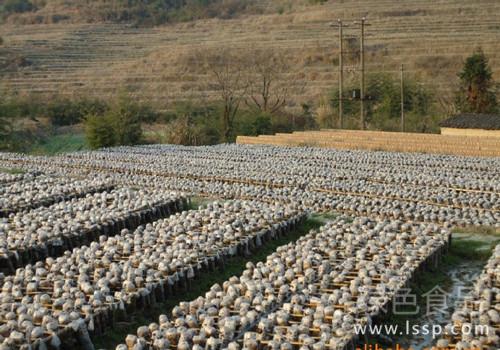
Straw mushroom
1. Choose a suitable substrate formula, build a pile and ferment:
For winter cultivation of straw mushrooms, a substrate formula with few nutrients and low yield cannot be used; a nutrient-rich, high-efficiency formula should be chosen. In production, the most commonly used are 68% cottonseed hulls, 20% rice straw, 1% urea, 6% lime, 3% calcium carbonate, 2% plant ash, or 77% waste cotton, 10% rice straw, 5% wheat bran, 8% lime. Use the two-stage fermentation method: first sun-dry the cottonseed hulls for 3-4 days, adjust the moisture content of the substrate to 70%-75% with lime water, with a pH of 7-8, pile it outdoors for 3 days, then move the substrate indoors and keep the room temperature at 60°C for about 2 days, or maintain the substrate temperature at 70°C for 10 hours.
2. Spawning and management before fruiting:
After the substrate fermentation is finished, adjust the moisture content to 65% and the pH to about 9. When the substrate temperature drops to 35°C, it can be spawned. A strip-laying broadcast spawning method can be used: divide the 80cm-wide bed into 5 equal parts, each strip 16cm wide, fill the middle strip with fertile soil, and fill substrate on both sides, with a substrate amount of 10 kg per sq m. After the substrate is laid, press it down lightly, scatter the spawn on the substrate surface at a rate of 4%-6% of the substrate weight, then scatter a layer of substrate over the spawn, and apply 5-6cm of fertile soil along the outer sides of the two substrate strips. Close the mushroom shed and bring the shed temperature to 30-35°C. Do not open doors or windows for 3 days to maintain high temperature and high humidity, which helps the mycelium germinate. After that, ventilate for about 20-30 minutes each day. After 4-5 days, when the mycelium has colonised 2/3 of the substrate, spray a small amount of water to encourage the mycelium to penetrate the substrate fully. After 6 days, when the mycelium has grown through the substrate, adjust the water supply adequately, strengthen ventilation and light exposure, and promote fruiting body formation. After 8 days, the mycelium begins to knot and mushroom buds appear. At this point, the substrate surface should be kept appropriately dry to increase mushroom formation and reduce dead mushrooms.
3. Strengthen management during the fruiting period and harvest in time:
About 10 days after spawning, dense small white dot-like mushroom buds can be seen appearing and gradually growing larger, and the first flush can be harvested at 13-15 days; the first flush accounts for 60%-70% of the total yield. Therefore, management of temperature, humidity, air and light should be strengthened. When the mushroom buds form, strengthen ventilation, expel stale air, and adjust the room temperature, keeping the room temperature at 32-34°C and the humidity at 85%-90%, reducing the amount of water sprayed and increasing the frequency of spraying. After each flush is harvested, clean the substrate surface in time. On the premise of keeping the mushroom house temperature basically stable, spray water to retain moisture, adjust the pH to slightly alkaline, and promote mycelium recovery. While replenishing water, some nutrient solution can also be applied, such as 0.1% urea and 5% bran water, to promote the differentiation and development of fruiting bodies. After 7 days, the second flush can be harvested. If the goal is to harvest two flushes, one production cycle takes about 20 days.
Straw mushrooms grow fast and often open their caps overnight, so they should be harvested in time. The best time to harvest is when the straw mushroom changes from a pagoda shape with a wide base and pointed top to an egg shape, when the texture changes from firm to soft and loose, when the colour changes from dark to light, and when the wrapper membrane has not ruptured and the cap and stipe have not extended out. Harvest once each in the morning, at noon and in the evening. For freshly harvested mushrooms, promptly trim off the soil on the surface of the mushroom base with a knife, and they can then be sold or processed.