The wheat tillering node does not die and can still overwinter safely; what are the control measures for dead seedlings?
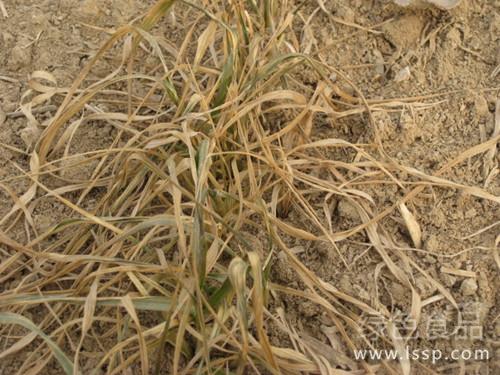
Dead wheat seedlings
Prevention and control of dead seedlings from freezing injury.Wheat has a strong self-regulating ability. Although it may suffer severe freezing injury during the overwintering period, as long as the tillering node does not die and remains white or green, it can still grow new tillers and form ears after greening up. As long as spring management is strengthened, a relatively good yield can still be obtained. Therefore, for wheat fields with dead seedlings during overwintering, management should grasp the word "early" and reflect the word "promote."
Rake away dead leaves to increase photosynthesis.In wheat fields with severe dead seedling conditions, there is little dry leaf cover on the ground, and the remaining green leaves are also covered by dry leaves, affecting wheat photosynthesis. When spring temperatures rise and the surface soil thaws, promptly use a rake to remove dead leaves from the wheat rows to promote the growth of the heart leaves.
Apply nitrogen fertilizer to promote recovery and vigor.After wheat greens up, apply 10-15 kg of urea early to promote the wheat seedlings to recover and gain vigor as quickly as possible.
Adapt to local conditions and water at the right time.Water flexibly according to ground temperature and soil moisture. Generally, water when the 5 cm ground temperature passes 5°C after wheat greens up. The amount of water should not be too large; light watering with a small amount of water should be used. For fields with good soil moisture, appropriately delay the watering time.
Foliar fertilization to supplement nutrients.After wheat suffers freezing injury, promptly spray 1-2 times with nutrient agents such as Yijia boron to supplement wheat nutrition and promote the wheat to resume growth as quickly as possible.
Intertillage and shallow hoeing to increase temperature and preserve soil moisture.After the surface soil of the wheat field thaws, carry out intertillage and shallow hoeing early to increase temperature and preserve soil moisture, promote the wheat seedlings to grow and develop early, increase tillering, and raise the ear-forming rate.
Prevention and control of overwintering dead seedlings caused by too shallow sowing: strictly follow the wheat sowing technical procedures, determine sowing depth according to soil moisture, and control the seeder's travel speed within 4 km per hour. Prevention and control of wheat seedling death caused by invasion of diseases and insect pests: use the land preparation process to eliminate pathogen residues in the soil, underground pests, and field mice. Make full use of measures such as seed dressing with seed coating agents for wheat seed.