How to control celery late blight: what to do when leaves blight, stems rot and small black spots appear
Celery late blight, also called late blight and leaf spot, commonly known as "fire dragon", is a common disease of greenhouse celery and affects celery yield and quality. In deep winter, low temperature and high humidity often favor the occurrence and spread of celery late blight. The symptoms and control methods of celery late blight are as follows.
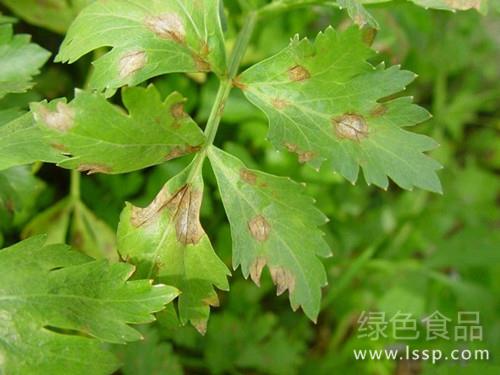
Celery late blight
I. Symptom expression.Celery late blight mainly damages leaves, followed by petioles and stems. Old leaves are affected first, from the outside inward. The lesions are initially light brown oil-soaked spots with obvious edges, then develop into irregular lesions, the color changing from light yellow to grayish white, with dark reddish-brown edges, and clustered small black grains, often with a yellow halo around the lesions. The lesions on petioles and stems are brown, oblong and slightly sunken, with scattered small black dots in the middle; in severe cases, leaves blight and stems rot.
II. Disease occurrence pattern.Celery late blight is a fungal disease, and low temperature and high humidity favor its occurrence. The suitable temperature for the disease is 20-25°C and the humidity is above 95%. In deep winter, during continuous cloudy days, with frequent temperature fluctuations, hot and dry daytime conditions, dew formation at night, weak celery growth, more irrigation, and untimely ventilation and dehumidification, the disease can often spread.
III. Control methods.
1. Balanced fertilization. Apply sufficient basal fertilizer and decomposed organic fertilizer, increase phosphorus and potassium fertilizer in topdressing, control the amount of nitrogen fertilizer, and spray foliar fertilizer and micronutrient fertilizer to enhance celery resistance.
2. Lower temperature and remove humidity. Keep the daytime temperature at 15-20°C; when it exceeds 20°C, ventilate promptly, and keep the nighttime temperature at 10-15°C to reduce the day-night temperature difference and reduce dew formation. Never use flood irrigation.
3. Chemical control. Use 45% chlorothalonil smoke agent to fumigate the greenhouse, 150 grams per mu, place it in 5-6 spots and ignite, fumigate for 1 night, once every 10 days. At the early stage of disease onset, spray 70% mancozeb wettable powder at 600 times dilution, or 50% carbendazim wettable powder at 600-800 times dilution, once every 7-10 days, spraying 2-3 times continuously, with obvious control effect.
4. Remove diseased plants. For greenhouses that have already developed the disease, promptly remove the celery diseased plant residues in the greenhouse to reduce the spread and expansion of the pathogen source.