Cucumber gummosis causes stems and vines to wither and die and fruits to become soft and rot; how should it be prevented and controlled?
In cucumber production, especially in greenhouse cultivation, gummosis is a common phenomenon in cucumber. When cucumber stems and vines ooze gum, the parts above gradually wither until they die; after the fruits ooze gum, their market quality is poor, and they may even become deformed or soft-rotted. In mild cases, yield is reduced by 20%--30%; in severe cases, there is total crop loss, seriously affecting returns. Gum is a product of cucumber leaf photosynthesis and is an essential nutrient for cucumber growth. After the plant becomes diseased, the phloem conducting tissue is cut off, causing photosynthetic products to overflow and resulting in gummosis. The diagnosis and control techniques for several common cucumber gummosis diseases are introduced below:
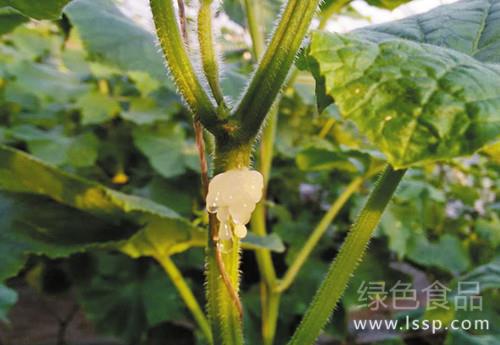
Cucumber gummosis
I. Diagnosis of gummosis disease symptoms
1. Cucumber scab
It causes severe damage to tender leaves, tender stems, young fruits and tendrils near the cucumber growing point. When the growing point is affected, it can rot away within 2--3 days, causing a bald stub. When leaves are infected, chlorotic nearly round lesions appear, later turning yellowish brown; after the lesions dry up, they perforate, with edges showing a star pattern. When stems and vines are affected, dark green water-soaked slightly sunken lesions grow, the epidermis becomes rough and scab-like, and after rupturing, gum oozes out; under humid conditions, the diseased part rots, which can cause part of the stem and vine to wither. When fruits are affected, gum begins to ooze, and dark brown sunken lesions grow; the lesions are scab-like, forming deformed fruits. Diseased fruits generally do not rot; under high humidity, a gray-black mold layer grows on the lesions. This disease prefers low temperature and high humidity and tolerates weak light. The optimum temperature is 15℃--22℃. When air humidity is above 90% and there are water droplets on the greenhouse roof and on the cucumbers, the disease occurs severely.
2. Cucumber phytophthora blight
It mainly damages leaves, stems and fruits. When leaves become diseased, dark brown water-soaked large round spots appear; when humid, they soft-rot, and when dry, they rupture in a pale white color. When stems are affected, they become water-soaked and soft-rotted, constricted, produce gummosis, and cause wilting. If several node areas of the cucumber become diseased, the whole plant quickly dries up. When fruits are affected, water-soaked dark green sunken lesions appear, secreting milky white gum that gradually turns amber, then softening and soft-rotting, with white mold growing on the surface and giving off a foul odor. The optimum temperature for this disease is 25℃--30℃. It occurs severely in open fields during high-temperature rainy summer and autumn periods and in plots with high soil moisture in greenhouses.
3. Gummy stem blight
It damages stems, leaves and fruits. This disease mainly starts at the stem node near the root crown, appearing light brown and water-soaked; after the tissue softens, gum oozes out and cracking occurs. In the later stage, the diseased stem dries up, and the lesions split longitudinally in a tangled hemp-like manner; in severe cases, the whole plant withers and dies. When leaves are affected, from the leaf edge inward they develop "V"-shaped or round brown lesions, which break easily when dry. When fruits are infected, yellow chlorotic spots appear; as the disease develops, the lesions become sunken in color, the fruits become deformed and curved, and sometimes amber gum overflows. The characteristic of gummy stem blight is that black small dots are evenly produced on all lesions. The optimum temperature for the pathogen is 18℃--25℃, and disease is likely when air humidity is above 85%. In continuous cropping land, when plants are weak in growth and drainage is poor, the disease is severe.
II. Control techniques
Scab: after finding diseased plants, pull them out promptly, bury them deeply or burn them, and at the same time spray 70% thiophanate-methyl wettable powder 800 times solution or a mixture of Hushu Dajiangjun stock solution 500 times solution and Xin Gao Zhi Mo 800 times solution; Phytophthora blight: spray 75% chlorothalonil wettable powder or 58% metalaxyl-mancozeb wettable powder 500 times solution + Xin Gao Zhi Mo 800 times solution; when central diseased plants are found, promptly handle diseased leaves and diseased plants; Gummy stem blight: spray 10% difenoconazole or 50% chlorothalonil or 70% thiophanate-methyl wettable powder 500 times solution + Xin Gao Zhi Mo 800 times solution; when cucumber stems and vines are infected, smear the affected areas with a rice-water paste made from any one of the above medicines at 50 times. Use various agents alternately, spraying once every 5--7 days, for at least two consecutive sprays.