Walnut saplings are prone to branch dieback in winter. What are the key points for cold protection?
Newly planted walnut trees are prone to branch dieback in winter. This is caused by the large pith, high water content and poor cold resistance of young walnut branches. Through investigation and research, walnut growers have summarized a set of management methods for cold protection of young walnut trees.
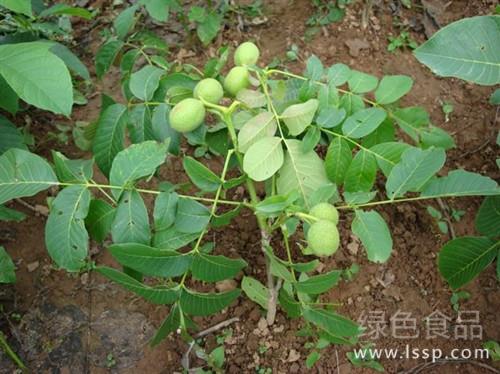
Young walnut trees
1. Burying in soil for cold protection:For 1-2 year old young walnut trees that cannot overwinter safely in the open field, cut the walnut saplings back to 15-20cm and then cover them firmly with soil. They will sprout the following year, and the covering soil can then be removed. This method is the most effective and most reliable measure for preventing branch dieback in walnut trees.
2. Mounding soil for cold protection:Build a mound of soil within 30cm around the base of the sapling to prevent freezing injury to the root crown and graft union of the walnut tree. Remove it after temperatures rise in the following spring, and level the tree basin.
3. Whitewashing for cold protection:Whitewashing young trees can reduce the temperature difference between the sunny and shady sides of the trunk, preventing freeze damage and sunscald to the main branch crotches and trunk. Whitewashing for cold protection has a good effect and can be applied before the soil freezes. Whitewash formula: 40 parts water, 10 parts quicklime, 2 parts lime sulfur mixture, 1 part table salt.
4. Wrapping with straw for cold protection:Wrap 1-3 year old young walnut trees after planting with straw for cold protection. In winter, use rice straw, burlap, woven bags, straw mats, etc. to wrap the trunk and main branch crotches, then tie both ends. This both blocks wind and protects against cold, helping young walnut trees overwinter safely.
5. Painting the trunk with polyvinyl alcohol:Evenly brush the prepared polyvinyl alcohol onto the main trunk of the walnut tree. Preparation method for polyvinyl alcohol: polyvinyl alcohol:water = 1:15-20 for boiling. First heat the water to about 50°C, then add the polyvinyl alcohol (do not wait until the water boils before adding it, otherwise the polyvinyl alcohol cannot fully dissolve and the solution will not be uniform). Stir while adding until it boils, then simmer over low heat for 20-30 minutes. Use after the temperature drops to where it is no longer hot to the touch.
6. Irrigation for cold protection:Irrigating walnut trees before freezing can store winter water for spring use to prevent spring drought and promote walnut tree growth. At the same time, it can also make use of water's ability to store more heat, keeping soil temperature stable during the cold winter period and reducing freeze damage to walnut trees.